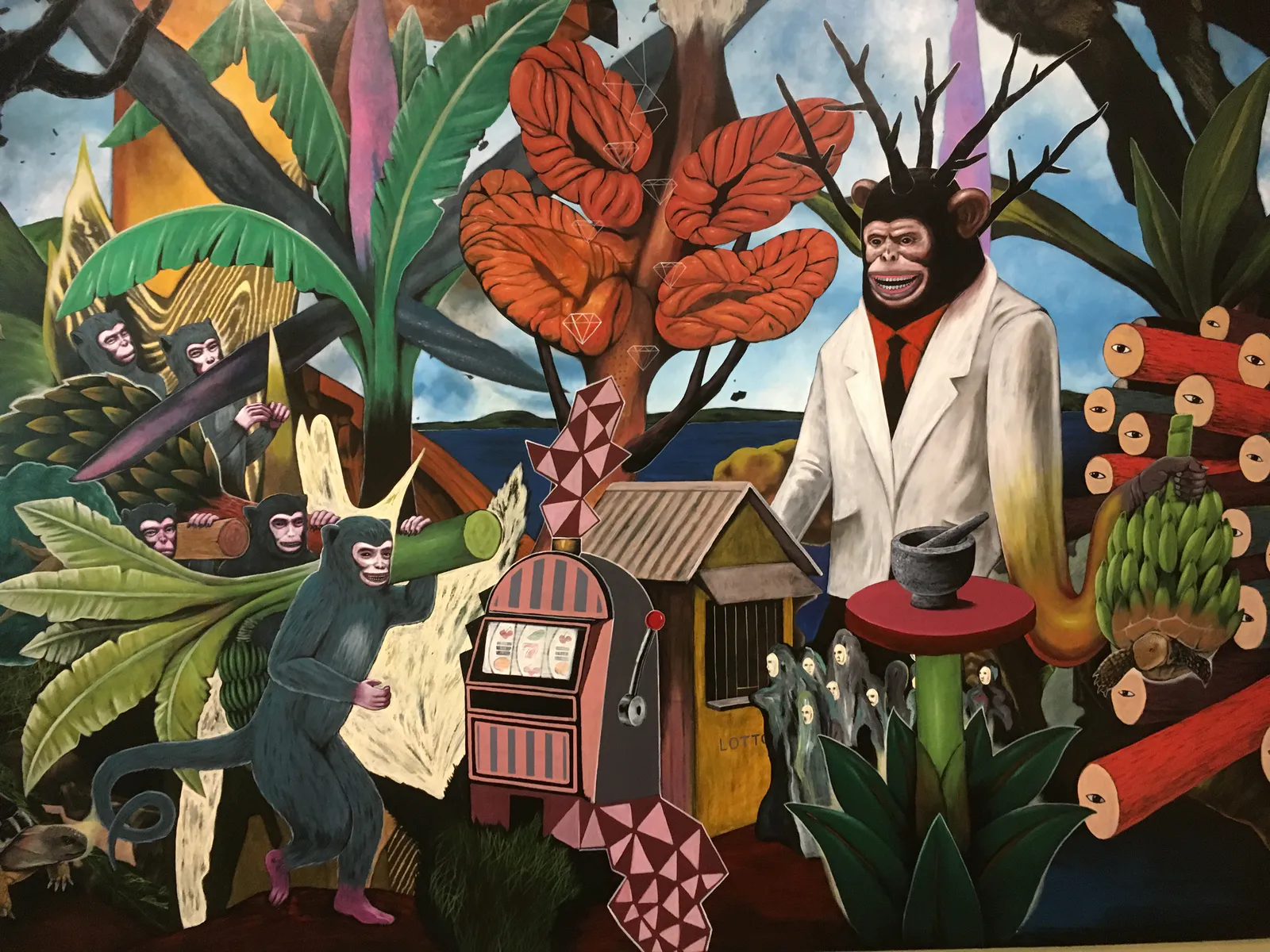
Instant Gratification
Rodel Tapaya
This work (2018) reinterprets the Filipino fable of The Monkey and the Turtle, placing its lesson within a crowded jungle of gambling stalls and restless figures. Monkeys embody the tale’s impatience and hunger for quick gain, while a small turtle-the steady effort outlasts reckless desire. Log piles, patterned trunks, and theatrical foliage frame a world driven by instant gratification and easy profit. Tapaya adapts indigenous storytelling to expose modern cycles of greed.
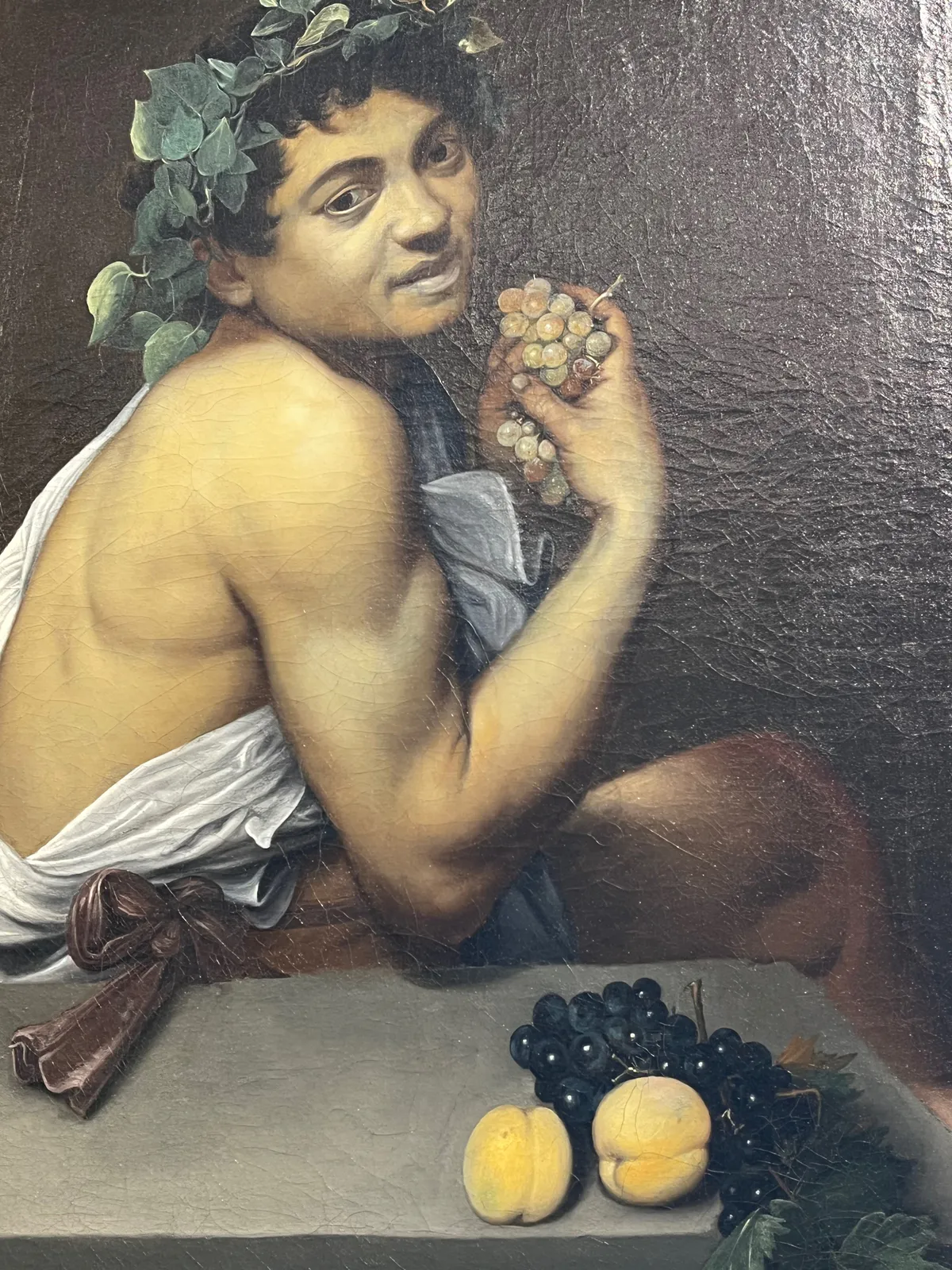
Young Sick Bacchus
Caravaggio
This self-portrait (c. 1593) shows Caravaggio as Bacchus with jaundiced skin and tense features, painted while recovering from illness. The ivy crown replaces the usual vine leaves, subverting divine idealism. Both sensual and unsettling, the image mocks classical beauty and reveals the artist’s own physical vulnerability.
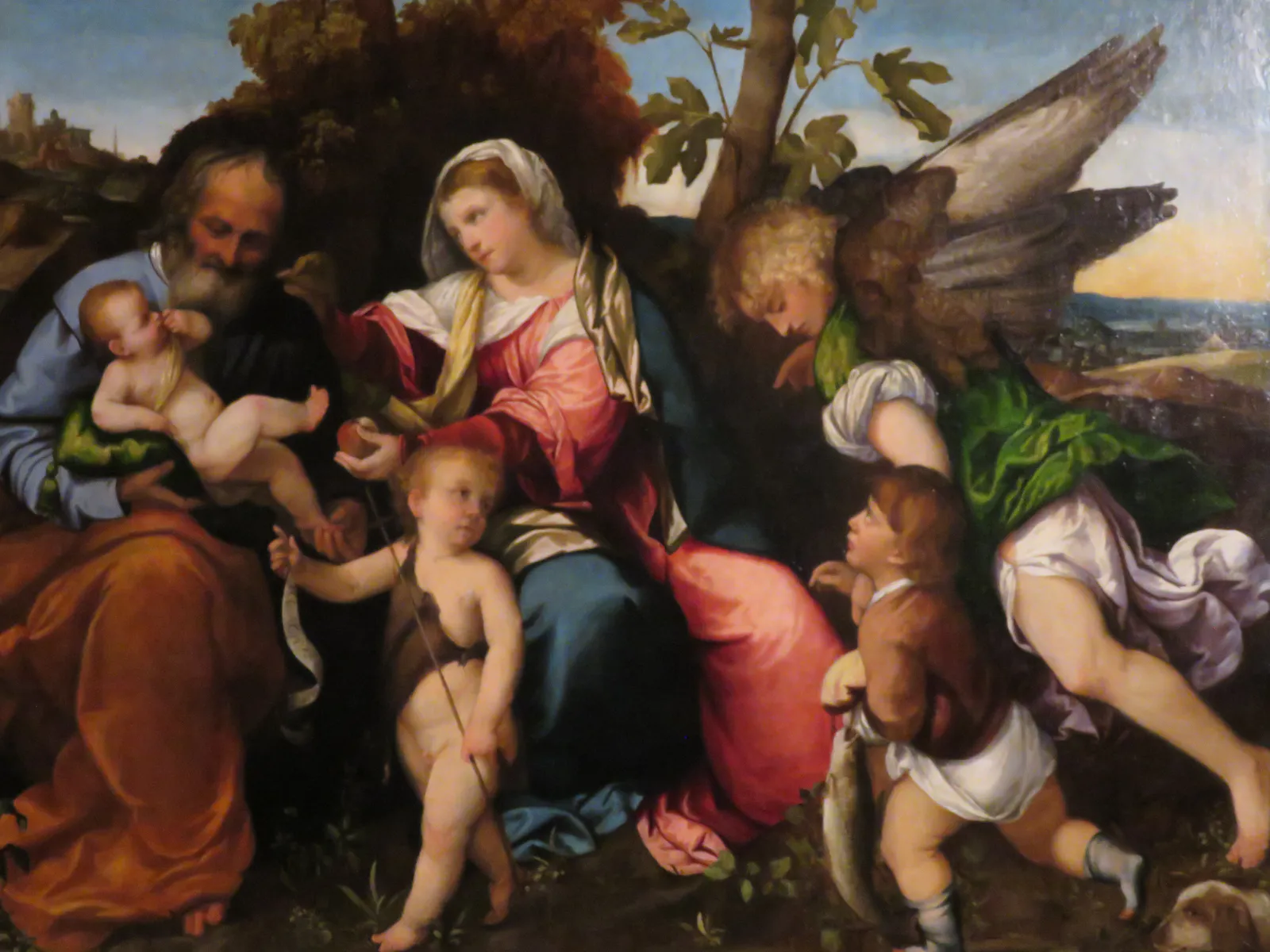
The Holy Family with Sts. Francis, Anthony, Magdalene, John and Elizabeth
Bonifazio Veronese
This oil on canvas (1525–27) shows the Holy Family seated outdoors, with Mary offering fruit to the Christ Child held by Joseph. At their side stand the young Saint John the Baptist and the Archangel Raphael guiding Tobias, who carries a fish. The combination of figures from different episodes may connect to Renaissance interest in linking domestic piety with protective intercession.
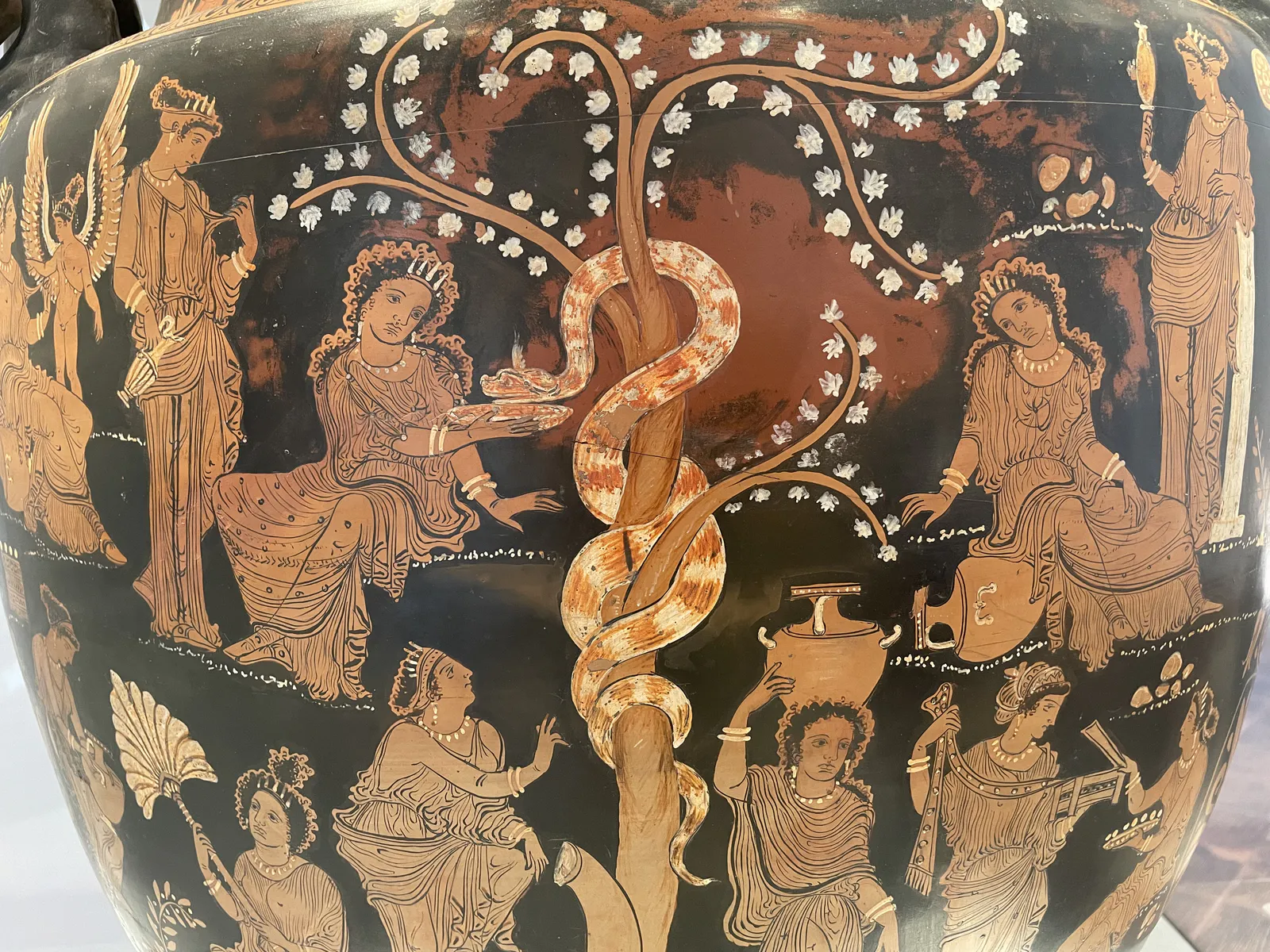
The Garden of the Hesperides
Lycurgus Painter
This Apulian red-figure volute krater (360–345 BC) shows maidens guarding the golden apples gifted by Gaia, with the serpent Ladon coiling around the sacred tree. Heracles is tasked with retrieving these apples in his final labor. The scene symbolizes the hero's triumph over peril, reflecting the ancient Greek themes of challenge and victory.
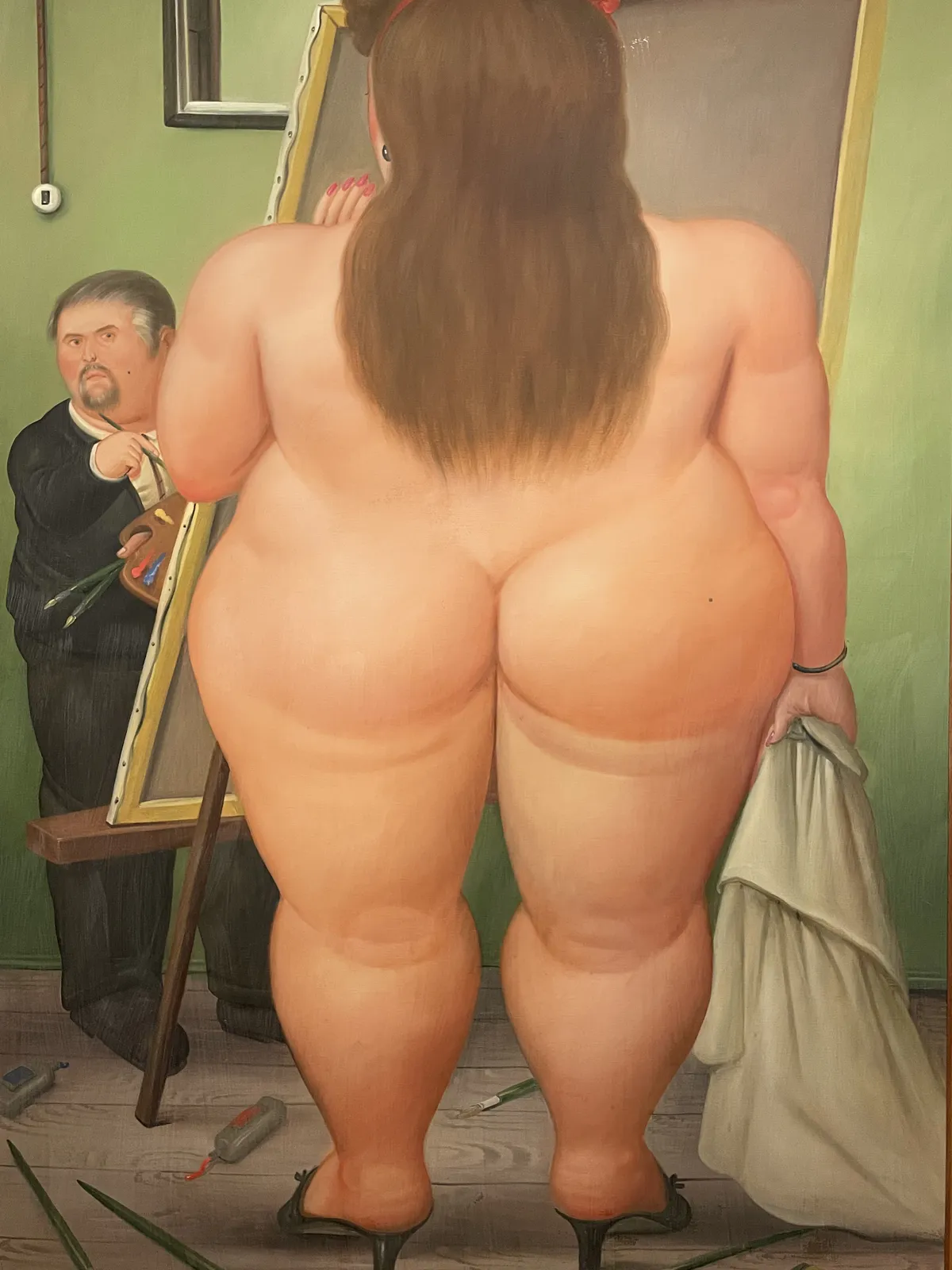
The Painter and His Model
Fernando Botero
Fernando Botero's The Painter and His Model (1984) humorously subverts the traditional artist-muse dynamic. The painting features a voluptuous nude model dominating the canvas, while the artist, dwarfed behind his easel, peers out with a palette in hand. This playful inversion highlights themes of power, beauty, and authorship, celebrating physical abundance with irony and affection. Botero's work invites reflection on the nature of artistic creation and the roles within it.
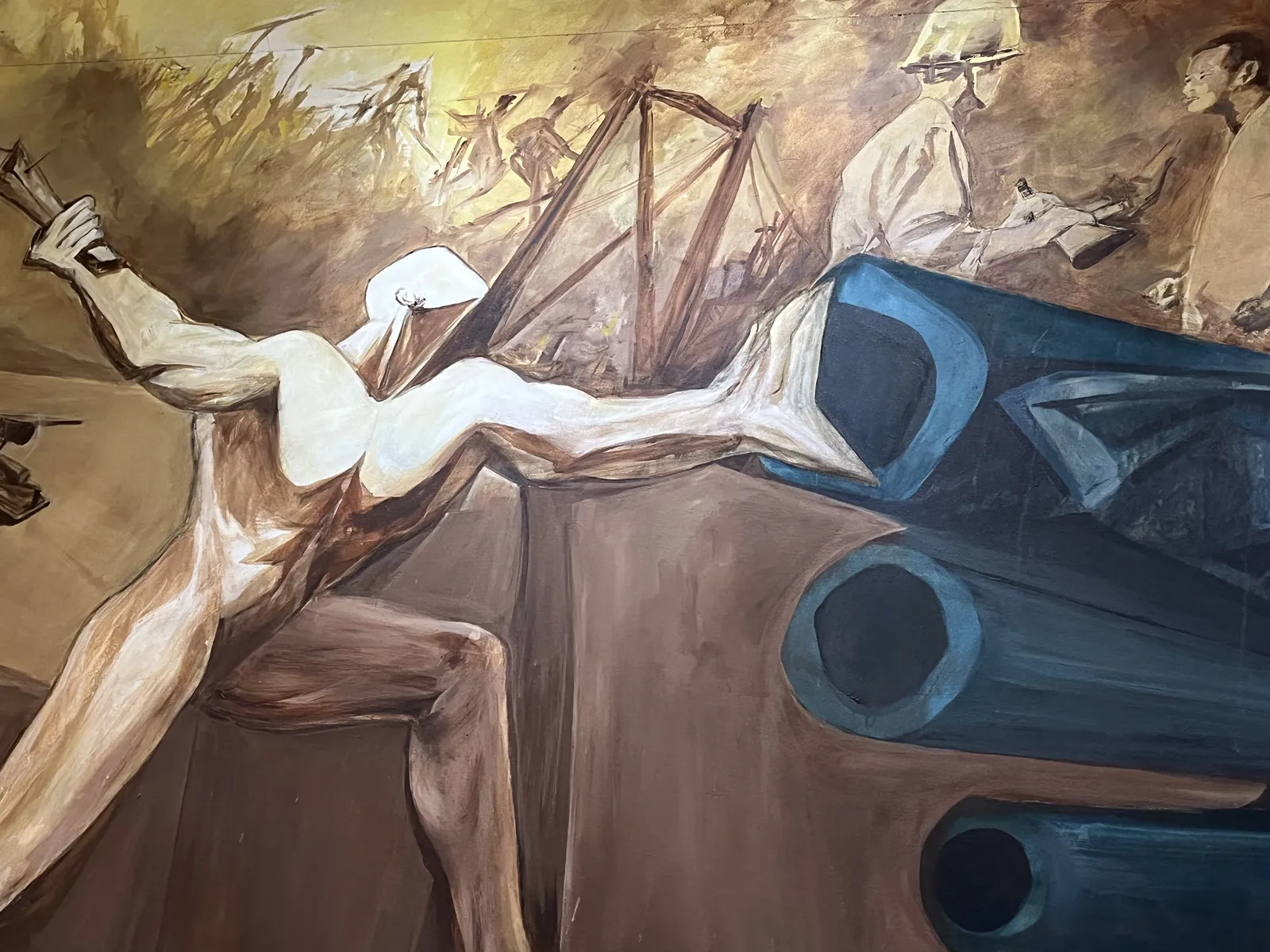
El pueblo en lucha
Ramón Oviedo
This mural (2013) shows a bound, faceless figure hurling itself toward the dark mouths of cannons, while ghostly soldiers and crowds emerge in the background. The scene recalls the Dominican struggle against dictatorship and foreign intervention in the 20th c. By fusing a single straining body with collective, blurred forms, Oviedo concentrates individual sacrifice into a broader history of resistance.
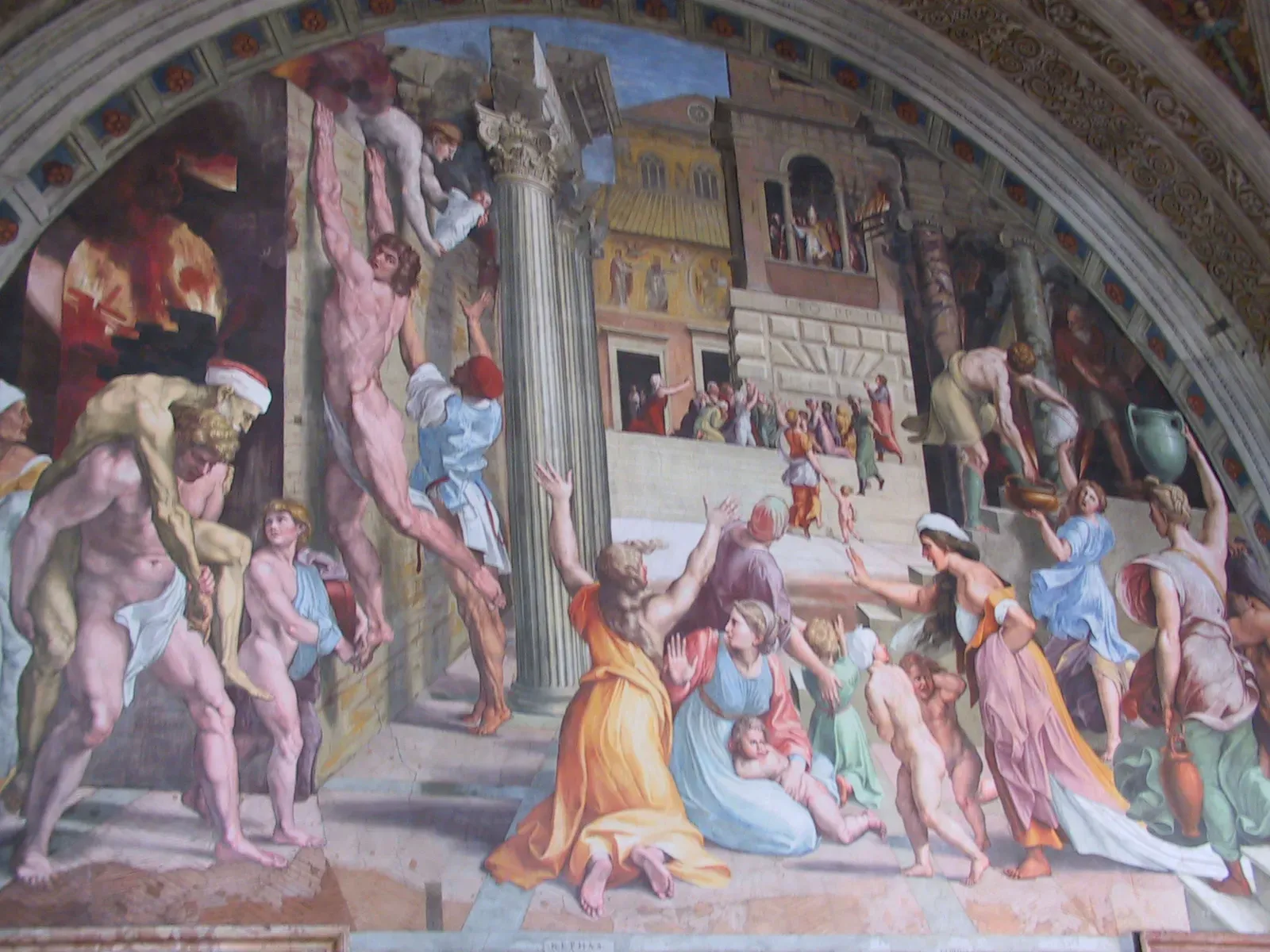
Fire in the Borgo
Rapahael and Giulio Romano
This fresco (1514) captures a legendary fire in Rome's Borgo district, illustrating divine intervention through Pope Leo IV's prayer. The fresco, part of the Raphael Rooms in the Vatican, blends classical and Renaissance elements, showcasing dynamic figures and architectural precision. This work reflects the era's belief in the power of faith and the church's central role in societal protection and order.
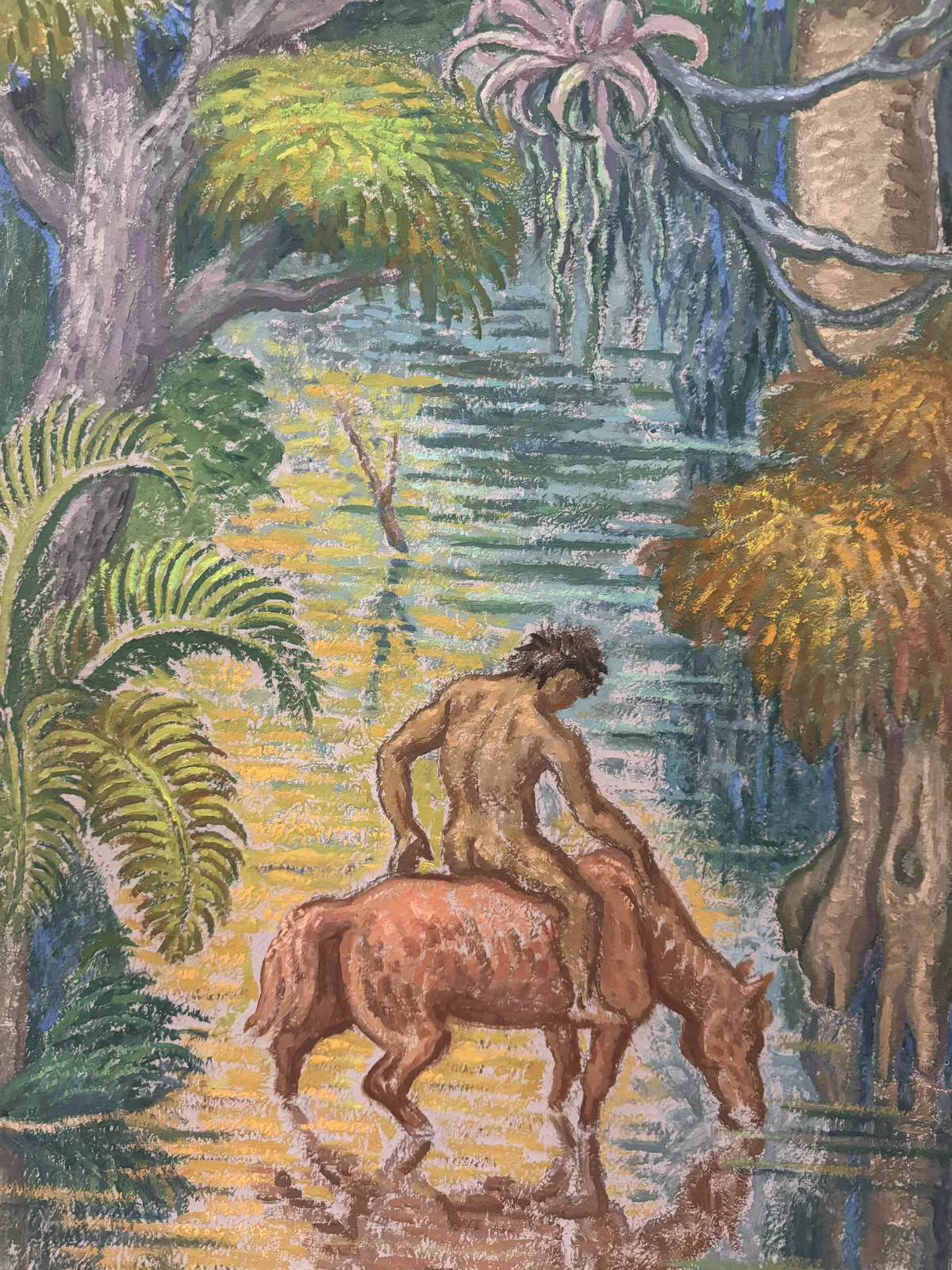
Indo-American Scene
Luis Alberto Acuña
A lone, naked rider on horseback drinks from a forest stream, immersed in a lush tropical setting. Acuña's painting (1950-60s) evokes a primordial connection between Indigenous people and the natural world, blending mythic and symbolic elements into a vision of harmony, solitude, and ancestral presence.
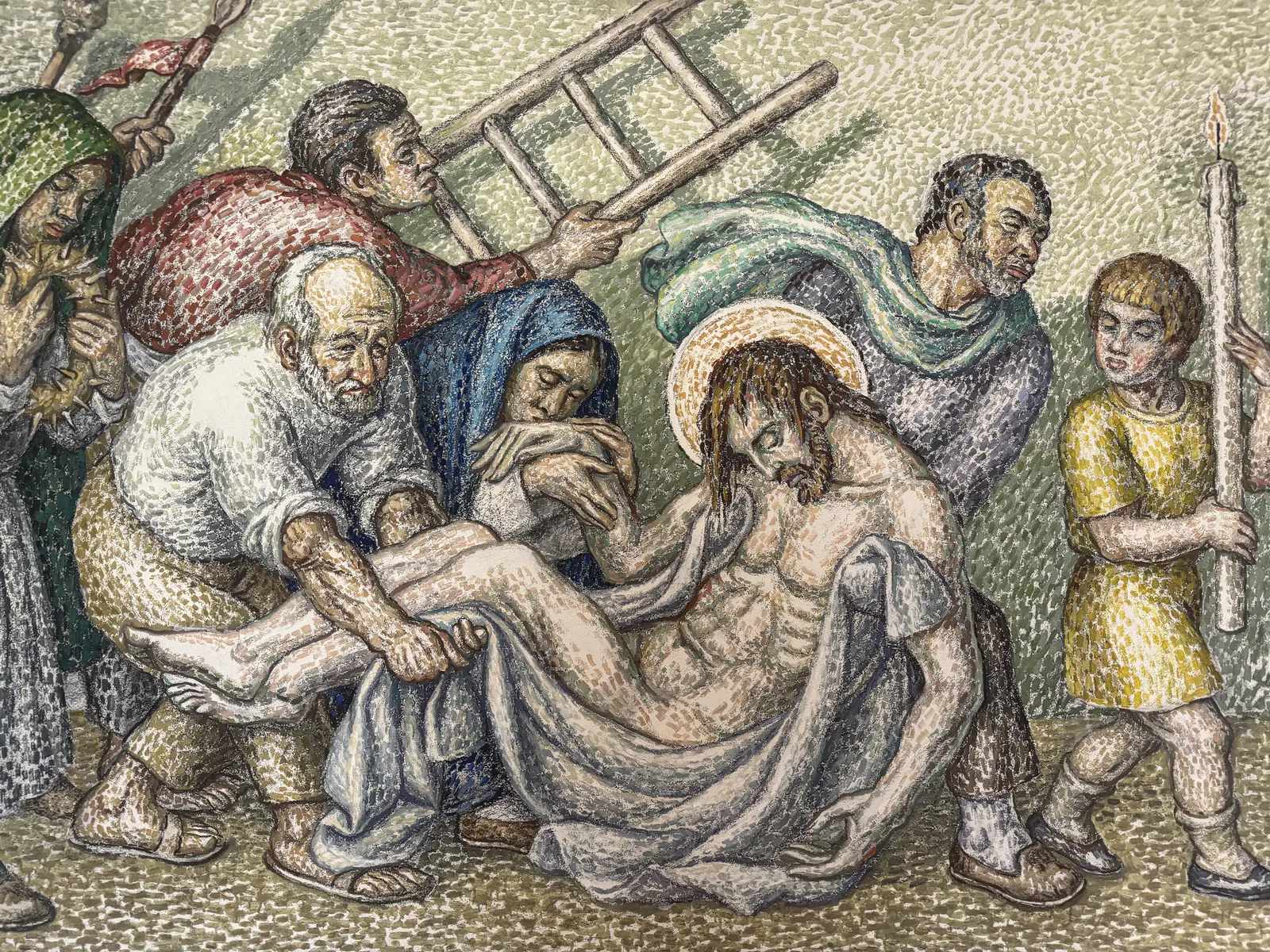
Descent from the Cross
Luis Alberto Acuña
Acuña (mid-1950s) renders the moment of Christ’s body being lowered from the cross with emotional gravity and communal sorrow. The composition emphasizes solidarity in grief, surrounding Christ with figures of all ages and backgrounds, reinforcing the universality of human suffering and compassion.
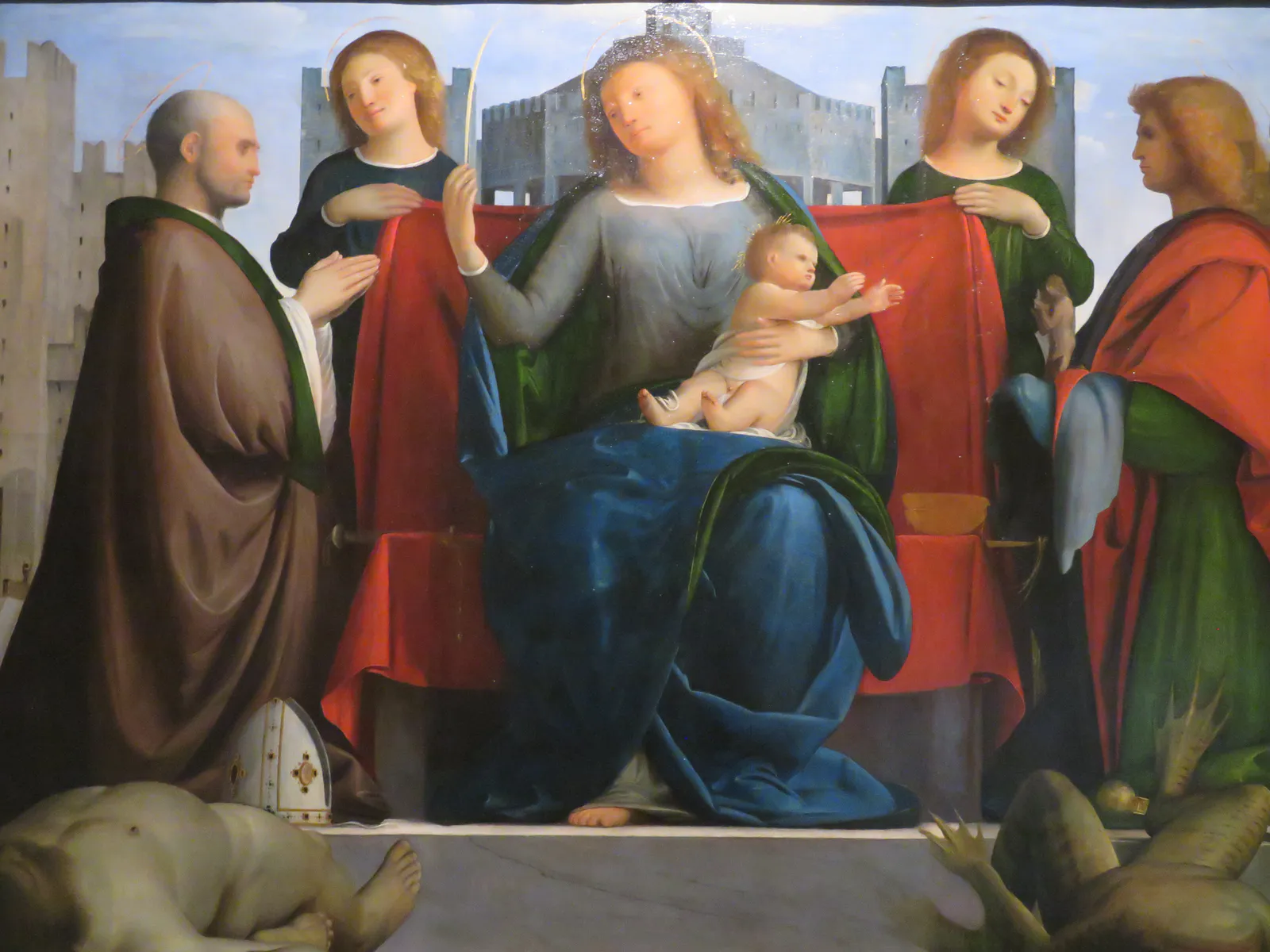
Madonna of the Towers
Bramantino
This tempera and oil painting (1515–20) presents the Madonna and Child enthroned between Saint Ambrose and Saint Michael. Set before fortified towers symbolizing Marian protection, the composition reflects Leonardo’s influence in its symmetry and restraint. Below, a toad representing the Devil lies defeated, underscoring the Virgin’s triumph over evil.
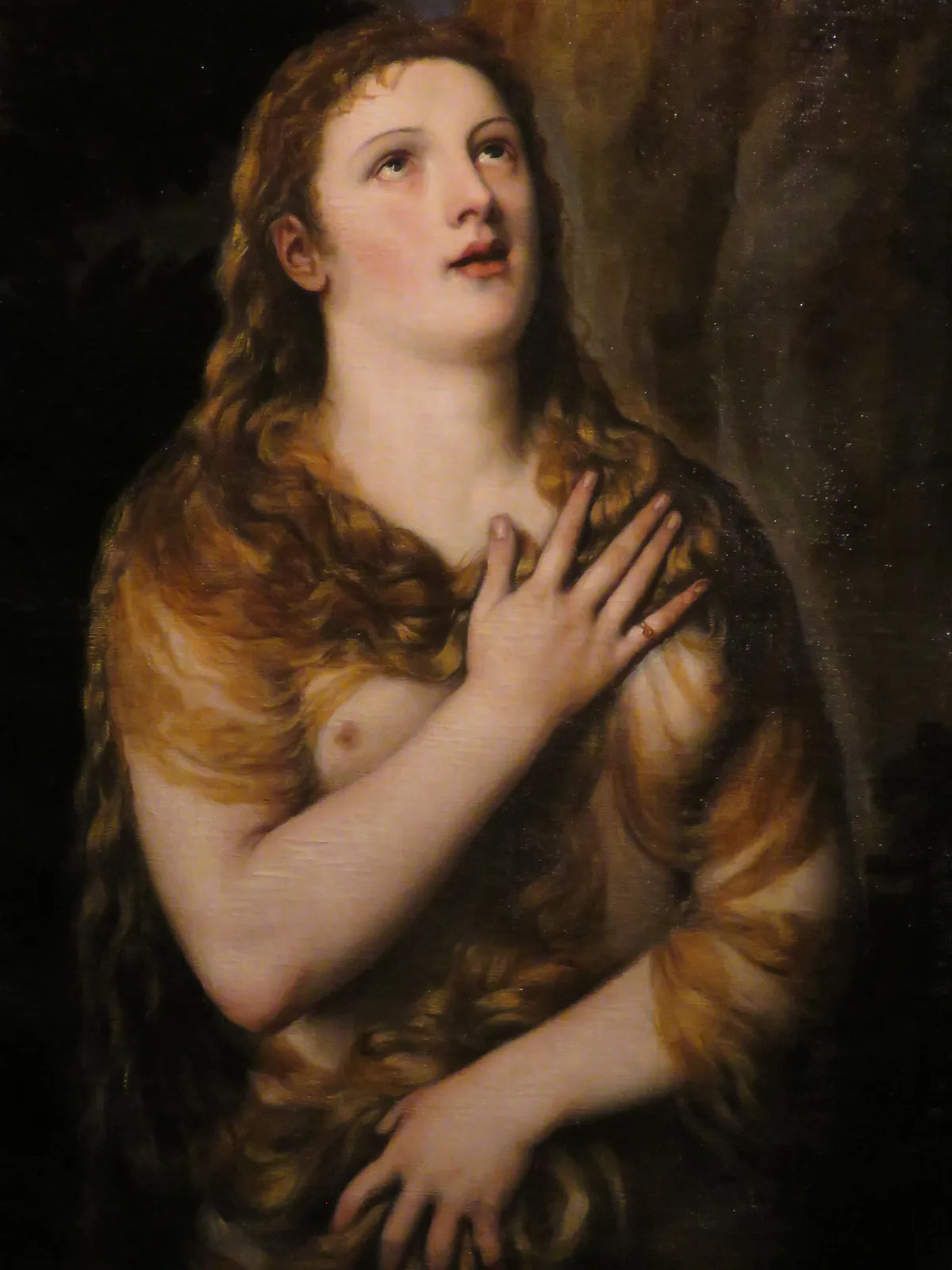
Mary Magdalene
Titian
This intimate portrayal of Mary Magdalene (c. 1560) captures the saint in a moment of spiritual ecstasy. Covered by cascading hair, her body becomes a vessel of penitence and divine grace. Titian’s sensual rendering reflects the Renaissance ideal of redemptive beauty and the transformative power of divine love.
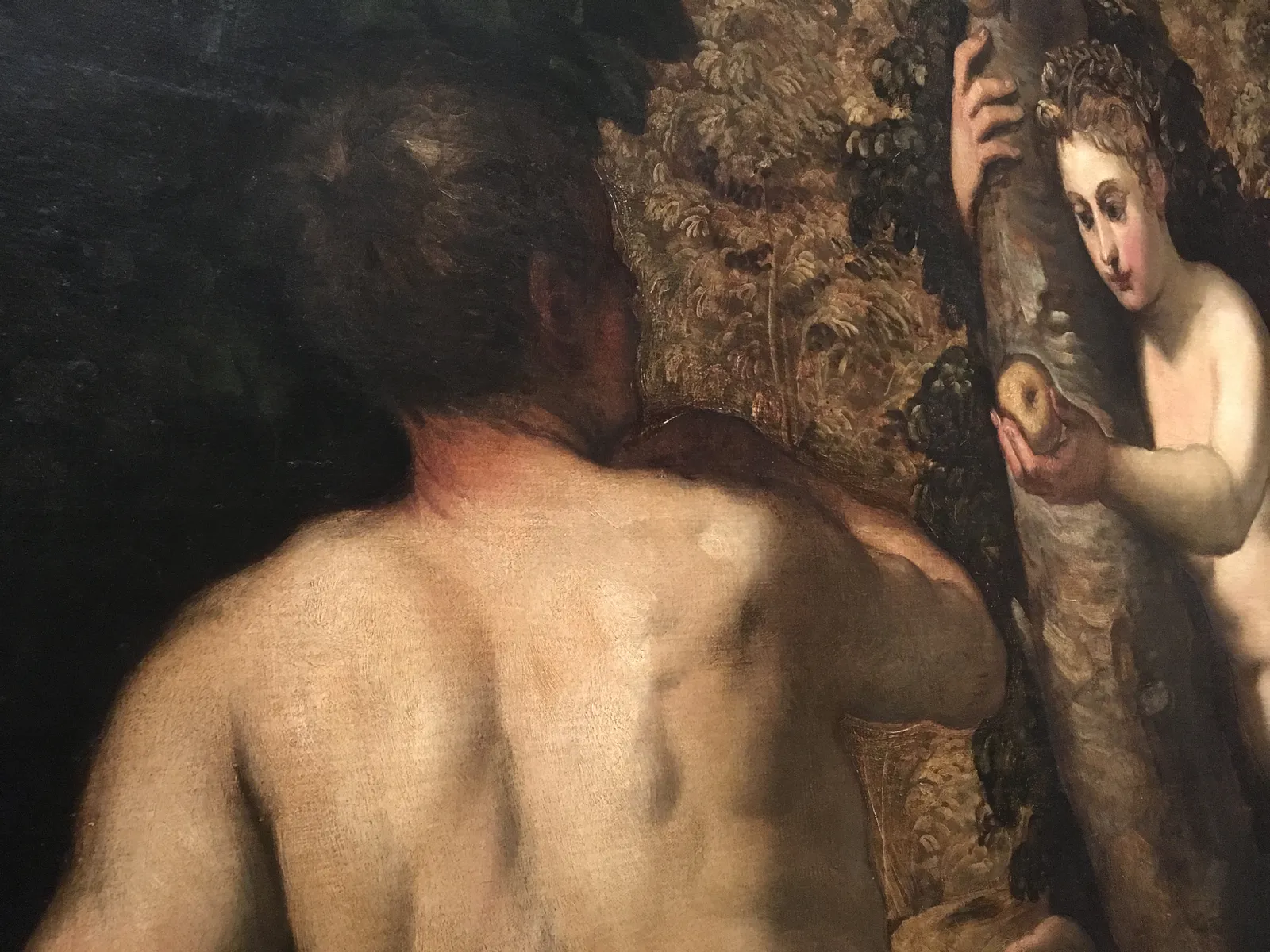
Adam and Eve
Tintoretto
Tintoretto’s painting (1550–53) depicts the biblical scene of temptation in the Garden of Eden. Eve offers the forbidden fruit to Adam, with their expulsion illustrated in the background. Influenced by Michelangelo, the composition emphasizes the nude figures and employs oblique lines to structure the landscape. This work reflects the Renaissance interest in human form and moral themes.
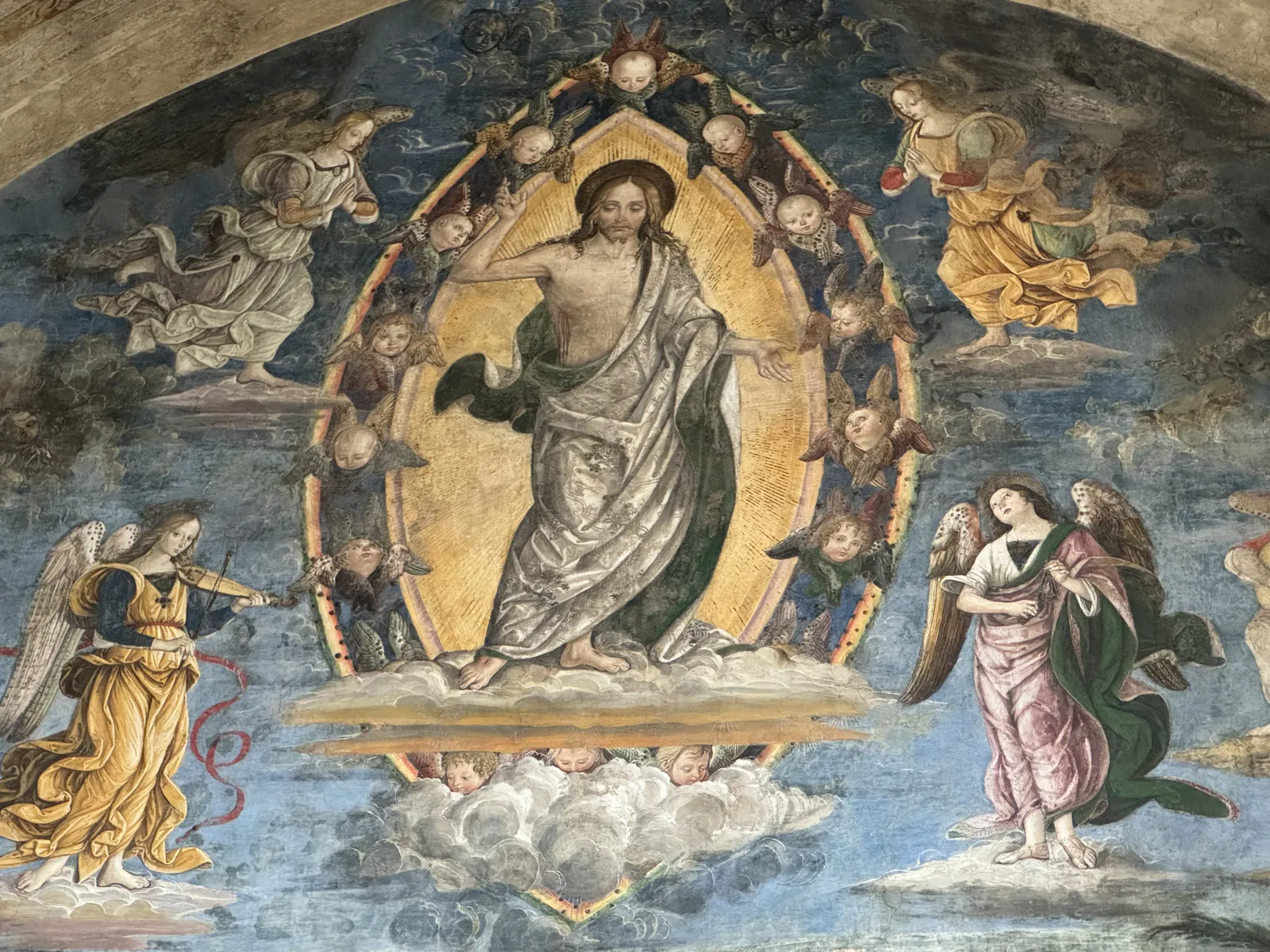
Christ in Majesty
Pinturicchio
Nikolo-Dvorishchensky Cathedral (1113) rises in compact tiers with clustered domes and narrow slit windows. Its pale plaster, often pink in daylight, stands in Yaroslav’s Court, the precinct founded by Yaroslav the Wise. Commissioned by Prince Mstislav to honor St Nicholas, it shaped the civic core of the Novgorod Republic and adapted Byzantine forms locally. The white building behind is part of the 17th-c. Merchant Court complex.
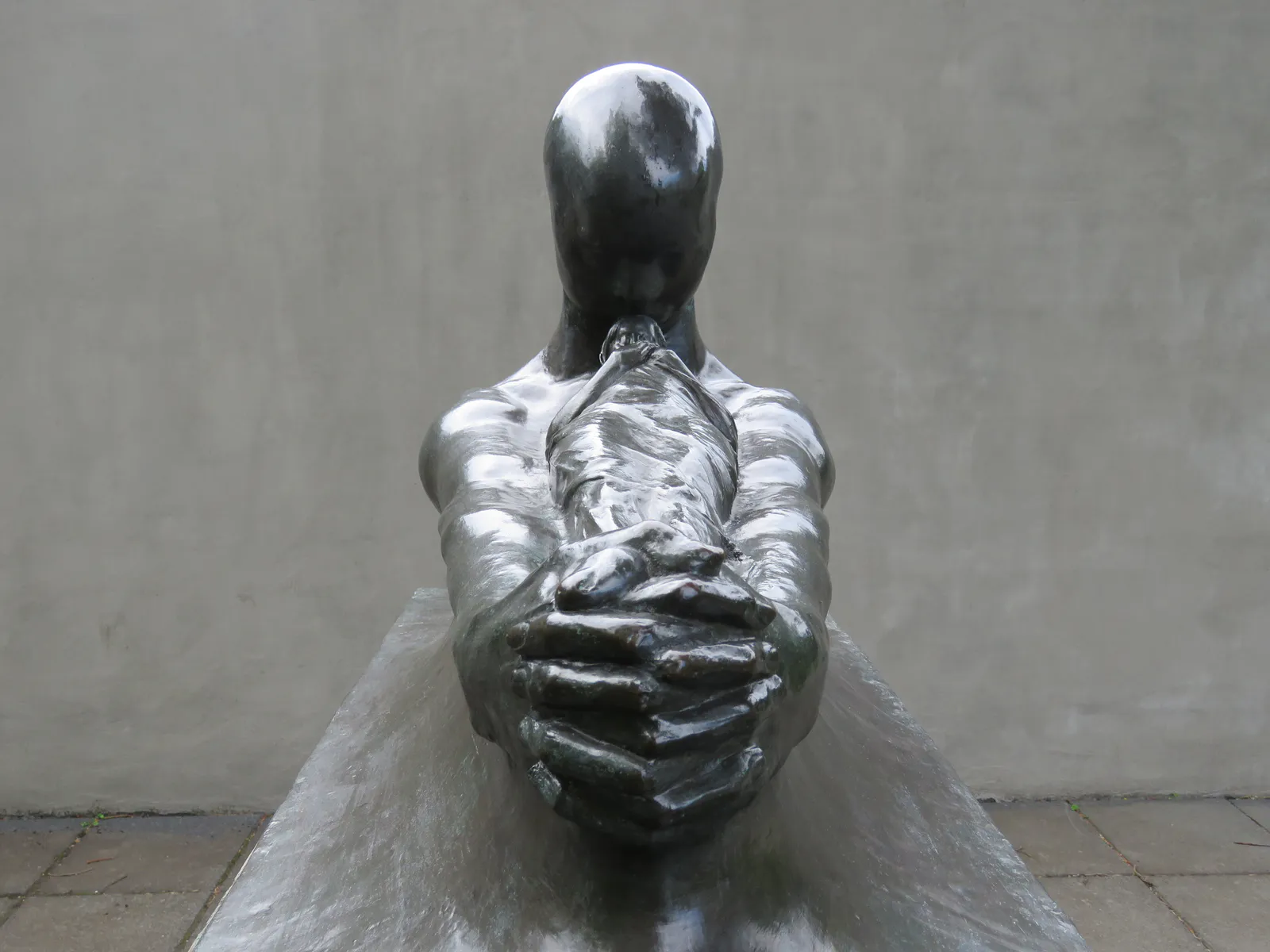
Earth (Mother Earth)
Einar Jónsson
Einar Jónsson’s sculpture (1904–1908) portrays a monumental figure cradling a smaller, draped form symbolizing Earth. Blending allegory and myth, it reflects Icelandic spirituality and cultural narratives. The work embodies humanity’s protective yet dependent bond with nature, inviting reflection on cosmic order and the fragility of existence.
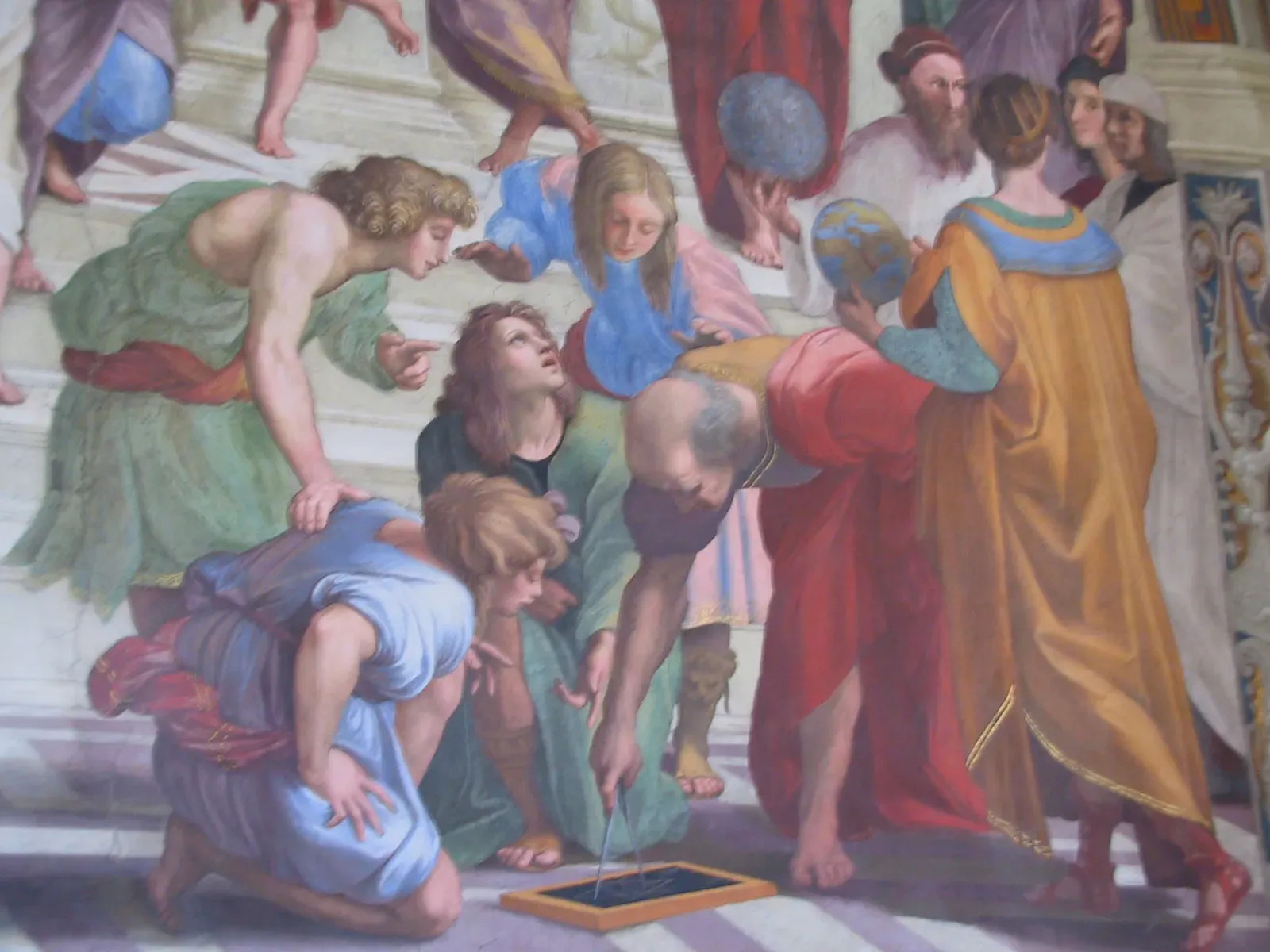
Euclid Teaching Geometry
Rapahel
In this vibrant lower-right scene from The School of Athens (1509–1511), Raphael presents Euclid demonstrating geometric principles with a compass. Painted in Rome during the High Renaissance, this detail celebrates empirical learning as foundational to human knowledge. The intense focus of his young onlookers reflects the Renaissance ideal of rediscovering ancient scientific wisdom through observation and reason.
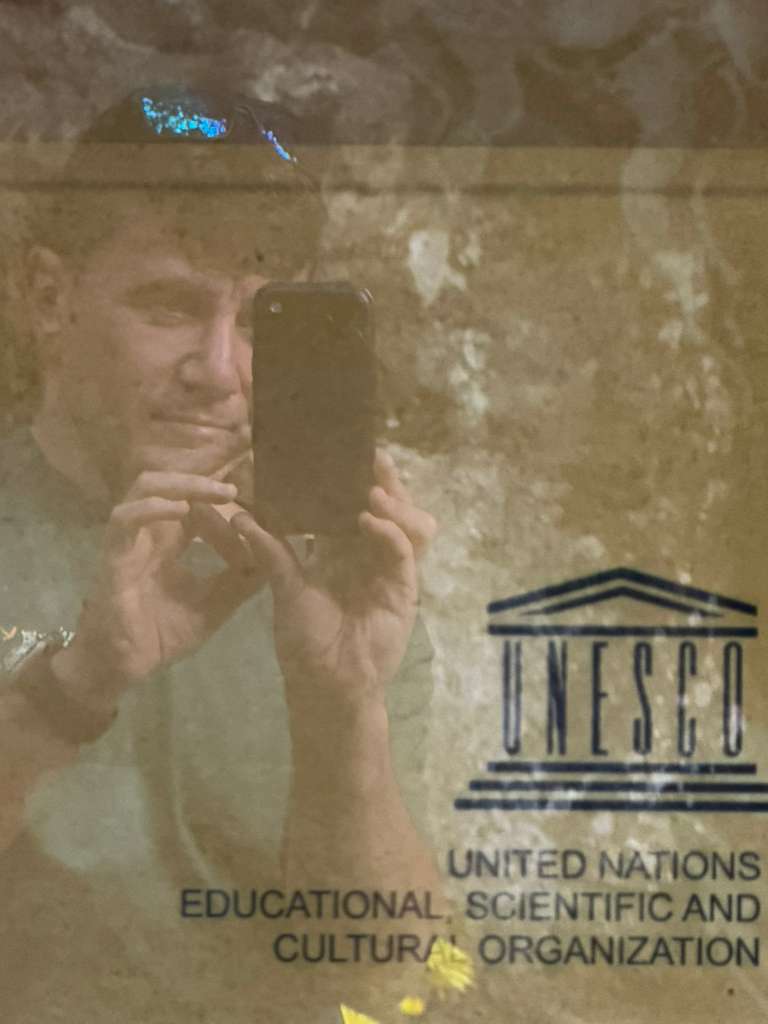
“When the path is beautiful, do not ask where it leads.” — Zen proverb
Welcome to my travel photography!
“When the path is beautiful, do not ask where it leads.” — Zen proverb
Welcome to my travel photography!
For as long as I can remember, my path has been one of discovery—seeking beauty, timelessness, and connection in every corner of the world. It has also been a journey of deep learning and understanding. I’ve been an avid traveler (or perhaps a travel addict?) for most of my life. My love for travel began long before I ever left home: as a child, I drew a fantasy map of my grandparents’ apartment and “traveled” through it with my cousin Sonya, imagining adventures in every corner. Nearly 90 countries and countless moments of awe later, I’m excited to share this journey with you.
Thanks to the tireless and ingenious programming of Diagilev, we’re now able to present about fifteen percent of the images I’ve accumulated over the years. More will be released in small batches depending on your interest. While the first release leans toward museum photography, later ones will include more nature, architecture, culture, and general travel experiences. If you’d like to receive email notifications about new releases, feel free to reach out—no commercial use, ever.
Throughout my travels, I’ve been drawn to two intertwined kinds of discovery. One is intellectual: learning why the world is the way it is. History became my guide, shaping my perspective and filling my camera roll with museums and old buildings. To me, history is not the past—it is the key to understanding the present and how the world became what it is. The other is emotional: seeking moments of elevation—spirituality, beauty, harmony—often found in nature, monasteries, and ancient sacred spaces. Together, these impulses shape my photography. It invites you to learn, admire, and soar—to rise above the mundane and see the world through a lens of curiosity and wonder.
Much of my later travel became possible thanks to my job with Delta Air Lines, but the wanderlust began years earlier. By the time I joined the industry, I had already visited over 35 countries and lived in several—largely thanks to a backpacking journey around the world with Luis León, whose face appears in many early photos. I grew up in Ufa in the USSR, and since leaving it I have lived, studied, and worked in Latvia, the United States, France, South Korea, Canada, Spain, Italy, Brazil, Japan, and Colombia.
A life of near-constant movement may seem a little crazy, but it has deepened my understanding of the world and produced the photography you are about to see. Over the years, my style has evolved—more intentional, more refined—yet its core remains the same: a search for understanding, timeless beauty, and a connection to those who walked this earth long before us.
I hope these photos stir something in your soul, just as they did in mine. I’d love to hear from you—whether reactions, suggestions, corrections, or a request to be added to the email list for new releases (no commercial use, I promise). You can learn more about my travels here, and my academic life here.
Enjoy our shared journey!