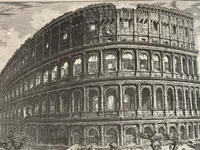
Etching of the Colosseum by Piranesi
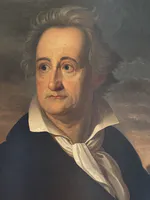
Portrait of Johann Wolfgang von Goethe
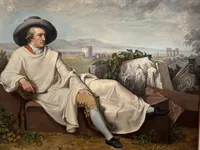
Goethe in the Roman Campagna
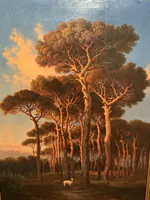
Evening Under Pinetrees
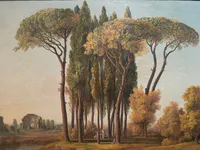
View from Monte di Giustizia
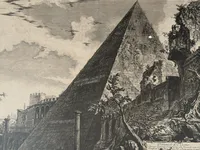
Pyramid of Cestius Etching by Piranesi
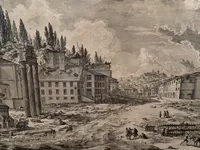
Site of the Ancient Roman Forum
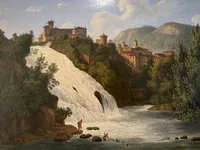
View of Cascata del Valcatoio Waterfall
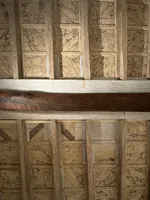
Ceiling of Goethe’s Room in Rome
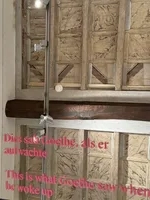
The Ceiling of Goethe's Romm in Rome
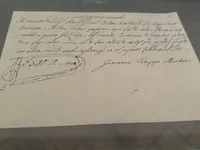
Receipt Signed by Johann Wolfgang von Goethe
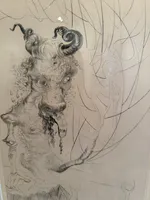
Demonic Figure
Goethe in Southern Italy and His Quest for the Primordial Plant
From Rome, Goethe made frequent excursions into the nearby countryside, especially the Alban Hills and Tivoli, where the celebrated landscape painter Jakob Philipp Hackert gave him drawing lessons. Together with Tischbein he travelled to Naples, arriving on 25 February 1787. The city and the smoking cone of Vesuvius captivated him; he climbed the volcano three times. Later works such as Franz Ludwig Catel’s small oil of Vesuvius and the Bay of Naples, and Tischbein’s idealised southern landscape with a Doric temple reminiscent of Paestum, recall the sights that so impressed him.
On 20 March 1787, Goethe sailed with draftsman Christoph Heinrich Kniep to Sicily. There, while reading Homer, he pursued his scientific quest for the primordial plant (Urpflanze)—a formal principle from which all plant forms might develop. Already on 27 September 1786 in the Botanical Garden of Padua he had sensed that all plant forms could perhaps develop from one. In the Palermo Botanical Garden, faced with luxuriant diversity, he wrote: It’s impossible that it doesn’t exist! How else would I recognise that this or that structure is a plant, if they were not all formed according to a single model? In his Italian diary he noted the hypothesis all is leaf, a simple rule generating infinite variety.
Goethe published his botanical research in 1790 as a study of the metamorphosis of plants. The term primordial plant disappears, replaced by an interest in the laws of plant formation and in the plant as a dynamic being. His drawings of plants and minerals, made throughout his life, reflect this union of scientific observation and artistic practice: the eye analyses form in nature, the hand records it, and art becomes a way of thinking with and through the living world.
On 20 March 1787, Goethe sailed with draftsman Christoph Heinrich Kniep to Sicily. There, while reading Homer, he pursued his scientific quest for the primordial plant (Urpflanze)—a formal principle from which all plant forms might develop. Already on 27 September 1786 in the Botanical Garden of Padua he had sensed that all plant forms could perhaps develop from one. In the Palermo Botanical Garden, faced with luxuriant diversity, he wrote: It’s impossible that it doesn’t exist! How else would I recognise that this or that structure is a plant, if they were not all formed according to a single model? In his Italian diary he noted the hypothesis all is leaf, a simple rule generating infinite variety.
Goethe published his botanical research in 1790 as a study of the metamorphosis of plants. The term primordial plant disappears, replaced by an interest in the laws of plant formation and in the plant as a dynamic being. His drawings of plants and minerals, made throughout his life, reflect this union of scientific observation and artistic practice: the eye analyses form in nature, the hand records it, and art becomes a way of thinking with and through the living world.
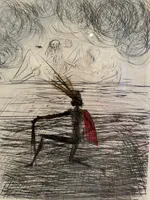
Kneeling Knight
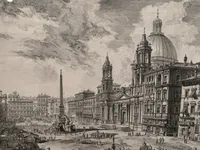
Piazza Navona with Fontana dei Quattro Fiumi
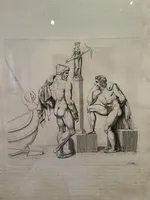
Homeric Dialogue
“All Is Leaf”: Goethe’s Search for the Primordial Plant
Goethe’s fascination with plants accompanied him throughout his life. One aim of his Italian journey was to investigate what he called the primordial plant (Urpflanze), originally conceived as a formal principle from which all plant forms might derive. On 27 September 1786, in the Botanical Garden of Padua, the idea gained shape: confronted with unfamiliar species, he wondered whether all plant forms could perhaps develop from one.
After visiting the Botanical Garden in Palermo in April 1787, Goethe felt that such an original plant must exist: It is impossible that it doesn’t exist! How else would I recognize that this or that structure is a plant, if they were not all formed according to a single model? In his Italian diary he sketched the hypothesis: Everything is leaf, and through this simplicity the greatest variety is possible.
He later published his botanical research in 1790 in The Metamorphosis of Plants. There the term Urpflanze disappears, replaced by an interest in the laws of plant formation and the plant as a dynamic, evolving being. Goethe’s drawings—of plants as well as minerals—reflect this analytical gaze. For him, artistic creation began with the trained eye, which observes natural forms, and the hand, which translates them into line. This close link between seeing and drawing, first refined in Italy, continues to inspire artists and viewers today.
⸻
After visiting the Botanical Garden in Palermo in April 1787, Goethe felt that such an original plant must exist: It is impossible that it doesn’t exist! How else would I recognize that this or that structure is a plant, if they were not all formed according to a single model? In his Italian diary he sketched the hypothesis: Everything is leaf, and through this simplicity the greatest variety is possible.
He later published his botanical research in 1790 in The Metamorphosis of Plants. There the term Urpflanze disappears, replaced by an interest in the laws of plant formation and the plant as a dynamic, evolving being. Goethe’s drawings—of plants as well as minerals—reflect this analytical gaze. For him, artistic creation began with the trained eye, which observes natural forms, and the hand, which translates them into line. This close link between seeing and drawing, first refined in Italy, continues to inspire artists and viewers today.
⸻
Franz Albert Venus and the Silent Waves of the Roman Campagna
In the 18th and early 19th centuries the rural belt around Rome, the Campagna Romana or Agro Romano, appeared as a marshy plain dotted with stagnant pools where malaria plagued shepherds and farmers during the summer. Travellers usually crossed it quickly along the Via Appia, on their way to the Alban Hills and ultimately to Brindisi; it was rarely a destination in itself, and early picturesque depictions are scarce. Only in the 19th century did landscape painters begin to treat the Campagna’s barrenness as an artistic challenge. Italian, German, Scandinavian and English artists turned to its low hills, ruins, cattle herds and mounted butteri, making the region a favourite motif.
Among them was Franz Albert Venus, who stayed in Rome in 1866/67 and again in 1869. He described the Campagna as a silent sea of finely curved, solidified waves of hills. His watercolour here shows an unidentified ruin northeast of Rome, in the area of today’s Monte Sacro district. On the horizon stands Monte Gennaro; to the left lies the village of Palombara Sabina. Typical reed huts of the Campagna’s inhabitants cluster beside the ancient structure. Yet despite these precise references, the work is above all an atmospheric study. Venus is less concerned with topography than with the play of light and colour over the waves of hills, whose horizontal rhythms are echoed by mountains and clouds, dissolving solid form into luminous bands.
Among them was Franz Albert Venus, who stayed in Rome in 1866/67 and again in 1869. He described the Campagna as a silent sea of finely curved, solidified waves of hills. His watercolour here shows an unidentified ruin northeast of Rome, in the area of today’s Monte Sacro district. On the horizon stands Monte Gennaro; to the left lies the village of Palombara Sabina. Typical reed huts of the Campagna’s inhabitants cluster beside the ancient structure. Yet despite these precise references, the work is above all an atmospheric study. Venus is less concerned with topography than with the play of light and colour over the waves of hills, whose horizontal rhythms are echoed by mountains and clouds, dissolving solid form into luminous bands.
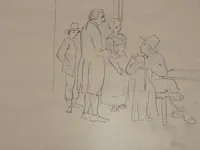
Goethe with His Landlord and Landlady
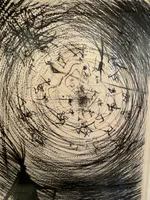
Illustrations for Goethe’s Faust
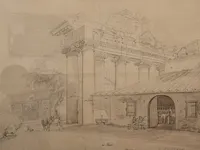
View of the Forum Romanum
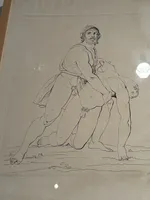
Nine Sheets from the Homer Series
Three Visions of Faust: Retzsch, Lindenschmit and Hegenbarth
Friedrich August Moritz Retzsch was among the first artists to tackle Goethe’s Faust in images. As early as 1808 he drew individual scenes, which he showed to Goethe in 1810. In 1816 he published an etching cycle of 26 plates that the poet praised for their witty compositions and the appealing character and expression of the figures. The drawing shown here repeats the second etching: Faust and his companion Wagner on their Easter walk, with Mephistopheles lurking at the right in the form of a poodle. Retzsch likely offered the drawing as an alternative to the printed sheet.
Wilhelm von Lindenschmit the Younger depicts Faust in the tavern of Auerbachs Keller, where Mephistopheles makes wine flow miraculously from the table to delight a circle of revellers. Faust, withdrawn and brooding, turns away, unimpressed by the spectacle. The drawing, dating to around 1850, relates to a now-lost painting by Lindenschmit.
Around 1960, Josef Hegenbarth illustrated the moment just before Faust signs the pact with the devil. Faust still hesitates, his head turned back in doubt, while Mephisto, with fleshy nose and sardonic grin, places a hand on his shoulder. A dark line seems to flow from the demon’s body into the scholar’s arm: Faust is already under Mephistopheles’ spell, his writing hand guided by the will of his infernal partner. Across a century and a half, these artists translate Goethe’s text into shifting visual interpretations of temptation, skepticism and surrender.
Wilhelm von Lindenschmit the Younger depicts Faust in the tavern of Auerbachs Keller, where Mephistopheles makes wine flow miraculously from the table to delight a circle of revellers. Faust, withdrawn and brooding, turns away, unimpressed by the spectacle. The drawing, dating to around 1850, relates to a now-lost painting by Lindenschmit.
Around 1960, Josef Hegenbarth illustrated the moment just before Faust signs the pact with the devil. Faust still hesitates, his head turned back in doubt, while Mephisto, with fleshy nose and sardonic grin, places a hand on his shoulder. A dark line seems to flow from the demon’s body into the scholar’s arm: Faust is already under Mephistopheles’ spell, his writing hand guided by the will of his infernal partner. Across a century and a half, these artists translate Goethe’s text into shifting visual interpretations of temptation, skepticism and surrender.
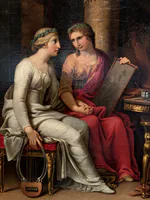
Allegory of Poetry and Painting
Hackert’s Waterfall at Isola del Liri: Art, Loss and Return
The painting shown here depicts the Cascata del Valcatoio at Isola del Liri, south of Frosinone and known in the 18th century as Isola di Sora. In the town centre the river Liri divides into two arms, forming two waterfalls: the cascade represented here and, behind it, the Cascata Grande. On the hill stands the Boncompagni Castle (owned by the Viscogliosi family since 1924), with the chapel of Santa Maria delle Grazie to the right; further right rise the twin towers of San Lorenzo Martire above the roofs.
Hackert discovered this site for art during an excursion in 1773 and was among the first to depict it. The painting, executed in 1794, is a meticulous landscape portrait that records buildings, water and terrain without idealisation, reflecting an Enlightenment interest in documentary precision that Goethe particularly admired.
Around 1900 the work belonged to Franz Rappolt (1870–1945), a wealthy Jewish textile merchant in Hamburg. In 1938 his firm was Aryanised, and he was forced to sell his company and later his villa. Rappolt was murdered in the Theresienstadt concentration camp in 1943. Before this, he had been compelled to sell Hackert’s painting at a low price to the dealer Hildebrand Gurlitt for the planned Hitler Museum in Linz. Seized by American forces in 1945, the work entered the collection of the Federal Foreign Office in Bonn. In 2017 it was restituted to Rappolt’s heirs, who placed it on permanent loan to the Casa di Goethe.
Hackert himself had lived near the Spanish Steps in Rome from 1768 to 1786 and was well acquainted with Tischbein. His painting thus returns, in a sense, to the circle of artists who once animated Goethe’s Roman world.
Hackert discovered this site for art during an excursion in 1773 and was among the first to depict it. The painting, executed in 1794, is a meticulous landscape portrait that records buildings, water and terrain without idealisation, reflecting an Enlightenment interest in documentary precision that Goethe particularly admired.
Around 1900 the work belonged to Franz Rappolt (1870–1945), a wealthy Jewish textile merchant in Hamburg. In 1938 his firm was Aryanised, and he was forced to sell his company and later his villa. Rappolt was murdered in the Theresienstadt concentration camp in 1943. Before this, he had been compelled to sell Hackert’s painting at a low price to the dealer Hildebrand Gurlitt for the planned Hitler Museum in Linz. Seized by American forces in 1945, the work entered the collection of the Federal Foreign Office in Bonn. In 2017 it was restituted to Rappolt’s heirs, who placed it on permanent loan to the Casa di Goethe.
Hackert himself had lived near the Spanish Steps in Rome from 1768 to 1786 and was well acquainted with Tischbein. His painting thus returns, in a sense, to the circle of artists who once animated Goethe’s Roman world.
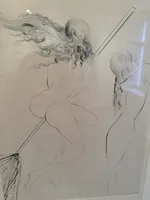
Illustrations for Faust
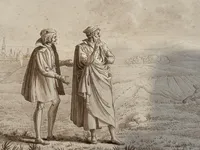
Faust and Wagner: Easter Walk
Franz Albert Venus and the Shimmering Hills of the Campagna
Franz Albert Venus, who stayed in Rome in 1866–1867 and again in 1869, considered the Roman Campagna one of his preferred motifs, describing it as a silent sea of finely curved, solidified waves of hills. The watercolour shown here depicts an unidentified ruin north-east of the city, in the area of today’s Monte Sacro district. On the horizon rises Monte Gennaro, with the village of Palombara Sabina visible to the left.
Next to the ancient structure and in the distant background stand small, tent-like reed huts, typical dwellings of Campagna inhabitants. Despite its many realistic details, the work is above all an atmospheric study. Venus concentrates on the shifting colours of the waves of hills, layered in horizontal bands whose rhythm continues in the mountains and clouded sky. Under the summer light, forms seem almost to lose their solidity, and the landscape dissolves into a play of light and colour.
Next to the ancient structure and in the distant background stand small, tent-like reed huts, typical dwellings of Campagna inhabitants. Despite its many realistic details, the work is above all an atmospheric study. Venus concentrates on the shifting colours of the waves of hills, layered in horizontal bands whose rhythm continues in the mountains and clouded sky. Under the summer light, forms seem almost to lose their solidity, and the landscape dissolves into a play of light and colour.
Winckelmann, Goethe, and the Ideal of Classical Antiquity
Supported by a Saxon court grant, Johann Joachim Winckelmann arrived in Rome in 1755 and became president of the Vatican collection of ancient art in 1763. With works such as Thoughts on the Imitation of Greek Works in Painting and Sculpture (1755) and History of the Art of Antiquity (1764), he is regarded as the father of art history and archaeology. He was the first to describe ancient artworks in detail and place them in broader historical contexts. By shifting attention from Roman to Greek art, which he praised as embodying noble simplicity and calm grandeur, he created the canon that shaped German Classicism.
In Monumenti antichi inediti (1767), Winckelmann traced the Greek roots of Roman art through 216 engravings of newly discovered antiquities, many drawn from the collections of Cardinal Alessandro Albani, whose librarian he became in 1759. Goethe encountered antiquity in Rome through Winckelmann’s lens; he already knew his writings via his drawing teacher Adam Friedrich Oeser. In Rome he then met the art historian Karl Philipp Moritz, whose influence led him to refine Winckelmann’s ideals, stressing artistic individuality and re-defining the relationship between art and nature. For Goethe, antiquity became not just a model to imitate, but a living measure for his own artistic and scientific pursuits.
In Monumenti antichi inediti (1767), Winckelmann traced the Greek roots of Roman art through 216 engravings of newly discovered antiquities, many drawn from the collections of Cardinal Alessandro Albani, whose librarian he became in 1759. Goethe encountered antiquity in Rome through Winckelmann’s lens; he already knew his writings via his drawing teacher Adam Friedrich Oeser. In Rome he then met the art historian Karl Philipp Moritz, whose influence led him to refine Winckelmann’s ideals, stressing artistic individuality and re-defining the relationship between art and nature. For Goethe, antiquity became not just a model to imitate, but a living measure for his own artistic and scientific pursuits.
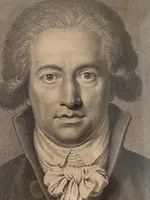
Portrait of Goethe
Goethe’s Roman Room on Via del Corso
During his first stay in Rome (1786–1787), Goethe lived in this part of the building on Via del Corso 18. Although the original furniture has not survived, documents in the display cases trace his journey from Carlsbad, which he left on 3 September 1786, to his life within the German artists’ community here. Evidence such as house registers and bills confirms his presence and everyday routines in what he called the capital of the world.
It is possible that Johann Heinrich Wilhelm Tischbein painted the famous watercolour Goethe at the Window in this very room. Elements from the drawing—terracotta floor and traditional wooden shutters—have been echoed in the exhibition design. Other sketches by Tischbein show the relaxed, bohemian life that Goethe had longed for in Weimar: shared meals, conversations, and artistic work rather than court duties. In Rome he also befriended the painter Angelika Kauffmann, who painted his portrait; after his departure, she wrote in May 1788 that the day he left was one of the saddest days of her life.
It is possible that Johann Heinrich Wilhelm Tischbein painted the famous watercolour Goethe at the Window in this very room. Elements from the drawing—terracotta floor and traditional wooden shutters—have been echoed in the exhibition design. Other sketches by Tischbein show the relaxed, bohemian life that Goethe had longed for in Weimar: shared meals, conversations, and artistic work rather than court duties. In Rome he also befriended the painter Angelika Kauffmann, who painted his portrait; after his departure, she wrote in May 1788 that the day he left was one of the saddest days of her life.
Johann Georg Schütz and the Temple of Saturn in Rome
Johann Georg Schütz (1755–1813) from Frankfurt was one of Goethe’s housemates in the shared artists’ apartment at Via del Corso 18. Having arrived in Rome in 1784, he moved within the circle of German artists and was a friend of Angelika Kauffmann. Schütz often acted as Goethe’s guide on walks through the city and was, as the poet noted, often useful. In 1788 he produced the preparatory drawings for Goethe’s Roman Carnival.
The drawing shown here depicts the Temple of Saturn in the Roman Forum. In Goethe’s time, systematic excavations had not yet begun; many monuments lay half-buried and overgrown, and the Forum, where cattle grazed, was known as the Campo Vaccino. The ancient temple, consecrated in 497 BCE, had even been adapted as a low horse stable, clearly visible in the sheet. In the background stands the Arch of Septimius Severus, still deeply sunk into the ground. Two men play the mandolin on a bench while a third, accompanied by a donkey and a dog, dances past. Schütz thus combines careful documentation of the ruin’s condition with a vivid glimpse of everyday Roman life, much as Goethe and he would have experienced it on their rambles through ancient Rome.
The drawing shown here depicts the Temple of Saturn in the Roman Forum. In Goethe’s time, systematic excavations had not yet begun; many monuments lay half-buried and overgrown, and the Forum, where cattle grazed, was known as the Campo Vaccino. The ancient temple, consecrated in 497 BCE, had even been adapted as a low horse stable, clearly visible in the sheet. In the background stands the Arch of Septimius Severus, still deeply sunk into the ground. Two men play the mandolin on a bench while a third, accompanied by a donkey and a dog, dances past. Schütz thus combines careful documentation of the ruin’s condition with a vivid glimpse of everyday Roman life, much as Goethe and he would have experienced it on their rambles through ancient Rome.
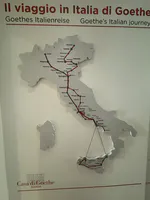
Goethe’s Travel in Italy
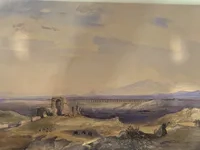
The Roman Campagna and Monte Gennaro
Faust: From Popular Legend to Goethe’s Life’s Work
Goethe began working on the figure of Doctor Faust between 1772 and 1773, drafting an early version known as the Urfaust in Frankfurt am Main. From this he developed Faust. A Fragment, completed in 1788 and published in Leipzig in 1790. An expanded version appeared in 1808 as Faust. A Tragedy. Late in life, between 1825 and 1831, he returned to the material again, composing Faust. The Second Part of the Tragedy, published posthumously in 1832.
The Faust legend, popularised by the chapbook The History of Doctor Johann Fausten (1587), had long been familiar to Goethe, who first encountered it as a puppet play in 1771/72. In Goethe’s drama, the world-weary scholar Faust promises Mephistopheles his soul if the devil can free him from dissatisfaction and grant him constant change. Rejuvenated, Faust seduces Gretchen, who bears his child; through his actions her brother and mother die. While Faust and Mephisto revel at the Witches’ Sabbath, Gretchen kills her child, repents, and awaits execution, refusing to flee and insisting on atoning for her guilt.
In Part One, Gretchen’s tragedy stands at the centre. In Part Two, the Faust story expands into a vast parable of humanity, history and striving. Goethe called the completion of Faust his main business. When he finally finished it, his friend and secretary Eckermann recorded the poet’s words: My further life I can now regard as a pure gift, and it is basically irrelevant whether and what else I do.
The Faust legend, popularised by the chapbook The History of Doctor Johann Fausten (1587), had long been familiar to Goethe, who first encountered it as a puppet play in 1771/72. In Goethe’s drama, the world-weary scholar Faust promises Mephistopheles his soul if the devil can free him from dissatisfaction and grant him constant change. Rejuvenated, Faust seduces Gretchen, who bears his child; through his actions her brother and mother die. While Faust and Mephisto revel at the Witches’ Sabbath, Gretchen kills her child, repents, and awaits execution, refusing to flee and insisting on atoning for her guilt.
In Part One, Gretchen’s tragedy stands at the centre. In Part Two, the Faust story expands into a vast parable of humanity, history and striving. Goethe called the completion of Faust his main business. When he finally finished it, his friend and secretary Eckermann recorded the poet’s words: My further life I can now regard as a pure gift, and it is basically irrelevant whether and what else I do.
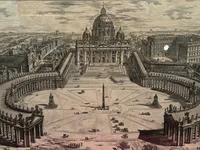
View of Vatican Basilica and Piazza
Goethe, Hackert, and an Enlightenment View of Isola del Liri
Jakob Philipp Hackert (1737–1807), a landscape painter from Prenzlau, settled in Rome in 1768 after years in Berlin and Paris and soon worked for Roman nobles and travelling patrons. In 1786 he was appointed court painter to Ferdinand IV in Naples. When the French conquered the city in 1799 he fled to Tuscany and later lived in Florence. Goethe met Hackert in Naples in February 1787; they quickly developed a friendship grounded in mutual respect and similar temperament. That summer they spent time together in Tivoli, where Hackert gave Goethe drawing lessons. Goethe later revised Hackert’s memoirs and published his biography in 1811.
The painting shown here, executed in 1794, depicts the Cascata del Valcatoio at Isola del Liri (then known as Isola di Sora), south of Frosinone. In the centre of the town, the river Liri splits to form two waterfalls: the Valcatoio, seen here, and the Cascata Grande behind it. Above rises Boncompagni Castle, with the Chapel of Santa Maria delle Grazie to the right and the twin towers of San Lorenzo Martire further back. Hackert first discovered this motif for art in 1773, and his detailed, unembellished depiction testifies to an Enlightenment, documentary approach to landscape that Goethe greatly admired. The painting’s later history—from the collection of Jewish merchant Franz Rappolt, through Nazi expropriation for the planned Hitler Museum, to post-war restitution and loan to the Casa di Goethe—adds a modern chapter to its biography.
The painting shown here, executed in 1794, depicts the Cascata del Valcatoio at Isola del Liri (then known as Isola di Sora), south of Frosinone. In the centre of the town, the river Liri splits to form two waterfalls: the Valcatoio, seen here, and the Cascata Grande behind it. Above rises Boncompagni Castle, with the Chapel of Santa Maria delle Grazie to the right and the twin towers of San Lorenzo Martire further back. Hackert first discovered this motif for art in 1773, and his detailed, unembellished depiction testifies to an Enlightenment, documentary approach to landscape that Goethe greatly admired. The painting’s later history—from the collection of Jewish merchant Franz Rappolt, through Nazi expropriation for the planned Hitler Museum, to post-war restitution and loan to the Casa di Goethe—adds a modern chapter to its biography.
Tischbein in Rome: History Painting and Artistic Allegory
Johann Heinrich Wilhelm Tischbein first stayed in Rome from 1779 to 1781. In 1780 he painted the history scene Oxyartes Gives His Daughter Roxane in Marriage to Alexander. The defeated Bactrian ruler Oxyartes sits on his throne while Alexander, at right, stands with his soldiers, offering a slain lion as a gift in his left hand and extending his right to Roxane. Tischbein had been studying Raphael’s works in Rome, including The Marriage of Alexander and Roxane in the Villa Farnesina, based on a Raphael design; the figure of Alexander there served as a model for his own composition.
After a period in Switzerland, Tischbein returned to Rome on 24 January 1783 and painted the Allegory of Poetry and Painting that same year. Poetry sits at left, holding a lyre; Painting, at right, presents a panel and clearly appears dominant. The canvas expresses the painter’s self-confidence: for Tischbein, painting was in no way inferior to poetry, represented in his Roman circle by his later housemate Goethe, who would move into the German artists’ community at Via del Corso 18 on 30 October 1786. Together, the two works document Tischbein’s first and second Roman sojourns: the allegory articulates his ideas about the arts, while the Alexander painting demonstrates his ambition and skill as a history painter.
After a period in Switzerland, Tischbein returned to Rome on 24 January 1783 and painted the Allegory of Poetry and Painting that same year. Poetry sits at left, holding a lyre; Painting, at right, presents a panel and clearly appears dominant. The canvas expresses the painter’s self-confidence: for Tischbein, painting was in no way inferior to poetry, represented in his Roman circle by his later housemate Goethe, who would move into the German artists’ community at Via del Corso 18 on 30 October 1786. Together, the two works document Tischbein’s first and second Roman sojourns: the allegory articulates his ideas about the arts, while the Alexander painting demonstrates his ambition and skill as a history painter.
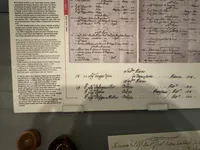
Goethes Residence in Rome 1787
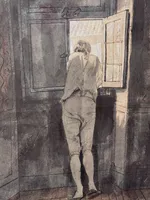
Goethe at the Window
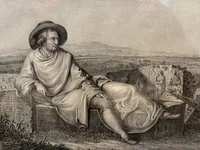
Goethe in the Roman Countryside
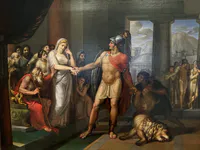
Hector and Andromache Farewell
Goethe’s Roman Household on Via del Corso
Arriving unexpectedly in Rome, Goethe first lodged in a modest inn before accepting painter Johann Heinrich Wilhelm Tischbein’s invitation to share an apartment on Via del Corso, just off Piazza del Popolo. Registered under the alias Giovanni Filippo Moeller, German, painter, he chose to live as an artist rather than as a Weimar minister. Research into household records shows that he likely covered most living expenses for his small circle of German friends and artists. Simple furnishings, informal sketches of Goethe in slippers at the window, and evenings spent reading and joking reveal a life stripped of courtly duties, devoted instead to study, friendship, and the rediscovery of himself in the Eternal City.
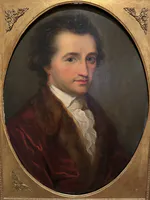
Portrait of Goethe
Goethe’s Italian Journey: A Relentless Quest for Rome
Diary of The Italian Journey
Goethe’s travel notes from 1786 trace an intense longing for Italy and, above all, for Rome. Slipping quietly out of Carlsbad before dawn, he races south, often ignoring sights along the way to satisfy his first need: to reach the city he has imagined for years. Detours to Lake Garda and Venice briefly delay him, but each diary entry circles back to Rome as his true goal—he even sleeps without undressing so he can depart at first light. On 28 October he finally writes, almost incredulous, that tomorrow evening Rome!—a moment he experiences as both the fulfillment of a destiny and the opening of a new life as an artist abroad.
Goethe’s travel notes from 1786 trace an intense longing for Italy and, above all, for Rome. Slipping quietly out of Carlsbad before dawn, he races south, often ignoring sights along the way to satisfy his first need: to reach the city he has imagined for years. Detours to Lake Garda and Venice briefly delay him, but each diary entry circles back to Rome as his true goal—he even sleeps without undressing so he can depart at first light. On 28 October he finally writes, almost incredulous, that tomorrow evening Rome!—a moment he experiences as both the fulfillment of a destiny and the opening of a new life as an artist abroad.
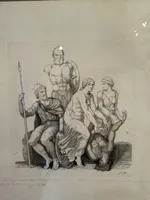
Nine Sheets from Homer Series
Goethe’s Secret Italian Journey and Roman Rebirth
In early September 1786, at the age of thirty-seven, Johann Wolfgang Goethe secretly set off on the longest and most decisive journey of his life. Leaving Weimar without warning friends or colleagues, he travelled incognito as the merchant Giovanni Filippo Moeller, fleeing official duties, social obligations, and his painful, unfulfilled love for the married Charlotte von Stein. Supported financially by Duke Carl August, he could travel without money worries, carrying the standard German guidebook Volkmann and manuscripts he had promised to finish for his publisher Göschen.
His route led over the Brenner Pass and Lake Garda via Verona, Vicenza and Venice, then through Ferrara, Bologna, Florence, Perugia and Assisi to Rome, the true goal of his longing since childhood, nourished by his father’s Italian souvenirs and views of Roman monuments. After 56 days, he entered the city on 29 October 1786 through the Porta del Popolo and soon wrote with relief: Yes, I have finally arrived in this capital of the world! In Rome he hoped for a personal rebirth through the encounter with antiquity in life and art. The travel diary, written above all for Charlotte, breaks off on his arrival and is replaced by letters announcing that Giovanni Filippo Moeller’s Roman adventure has begun.
His route led over the Brenner Pass and Lake Garda via Verona, Vicenza and Venice, then through Ferrara, Bologna, Florence, Perugia and Assisi to Rome, the true goal of his longing since childhood, nourished by his father’s Italian souvenirs and views of Roman monuments. After 56 days, he entered the city on 29 October 1786 through the Porta del Popolo and soon wrote with relief: Yes, I have finally arrived in this capital of the world! In Rome he hoped for a personal rebirth through the encounter with antiquity in life and art. The travel diary, written above all for Charlotte, breaks off on his arrival and is replaced by letters announcing that Giovanni Filippo Moeller’s Roman adventure has begun.
Goethe MuseumCasa di Goethe
Goethe Museum occupies the artists’ house on Via del Corso where Johann Wolfgang von Goethe lived in 1786–88 under the alias Giovanni Filippo Möller, the decisive Roman pause behind his Italian Journey and later classicism. Manuscripts, prints, and city views evoke a foreign writer reshaping himself through antiquity, landscape, and the studio friendships of Rome’s German community. It endures as a compact record of how the city fed modern European art and thought—and the long shadow of Faust.
Explore by type and place