The 20th Century and the Rise of Global Human Rights
The 20th c. expanded human rights into a global framework. The League of Nations (1919) attempted collective security after World War I, followed by the creation of the United Nations (1945). In 1948, the UN adopted the Universal Declaration of Human Rights, led by Eleanor Roosevelt, establishing a universal moral and legal standard. Later declarations defended children’s rights (1959) and condemned apartheid (1991). Colombia’s 1991 Constitution reaffirmed dignity, equality, and pluralism, seeking to heal longstanding conflicts and strengthen democratic citizenship.
19th-Century Independence Movements and Legal Reform
The 19th c. brought revolution and codification. In 1810, Colombia’s Grito de Independencia launched its struggle for autonomy, while Nariño’s 1811 Memorial of Grievances denounced colonial injustices. France’s Napoleonic Code (1804) spread modern civil law emphasizing equality and property rights. In 1791, Olympe de Gouges demanded women’s equality in her Declaration of the Rights of Woman—an act that cost her her life but left a lasting legacy.
Abolition and the Long Fight to End Slavery
Ending slavery was one of history’s most difficult human-rights battles. In Colombia, gradual manumission began in the 1820s, granting freedom to children born to enslaved mothers. Full abolition arrived only with the 1851 Ley de Manumisión. In the United States, slavery ended in 1865 with the 13th Amendment after the Civil War. Though incomplete and hard-won, these victories marked a major turning point in global recognition of human dignity.
Beyond Human Rights: Tracing the Deep Roots of Justice
Human rights have deep historical origins rooted in humanist thought and early ideas of dignity. They gained new force with the U.S. Declaration of Independence (1776) and France’s Declaration of the Rights of Man (1789). In Colombia, Antonio Nariño’s 1793 translation of the French text became a symbol of defiance and a catalyst for independence. Yet these ideals echo much older traditions shaped by ancient civilizations and their early concepts of justice.
Enlightenment Revolutions and the Birth of Modern Rights
The 18th c. transformed rights into political doctrine. The U.S. Declaration of Independence (1776) asserted inherent equality and unalienable rights, inspiring movements across the world. France’s Declaration of the Rights of Man (1789) proclaimed liberty, property, and resistance to oppression. Nariño’s bold translation and publication of this document in 1793 galvanized Colombian revolutionary thought and became a cornerstone of Latin American political identity.
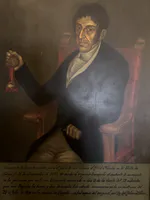
Dying Antonio Nariño

Final Days of Antonio Nariño

Prison Cell of Antonio Nariño
Early Modern Reforms and Emerging Claims to Freedom
In the 17th c., new legal protections emerged. Sir Edward Coke’s Petition of Right (1628) insisted on limits to royal power, while England’s Declaration of Rights (1689) established parliamentary authority and constitutional monarchy. At the same time in the Americas, enslaved Africans formed autonomous communities known as palenques. In Colombia and elsewhere, these maroon societies resisted colonial rule and embodied early claims to freedom and human dignity.

Andalusian Courtyard of Nariño’s Last Home
Antiquity and the World’s Earliest Legal Codes
Ancient societies created the earliest legal frameworks for justice and rights. The Sumerian Code of Ur-Nammu (c. 2050 BCE) introduced principles of fairness and restitution, followed by the Babylonian Code of Hammurabi (c. 1700 BCE), known for its proportional eye for an eye doctrine. In South Asia, the Code of Manu (1280–880 BCE) outlined duties but reinforced caste hierarchy. Greece produced the severe Code of Draco (621 BCE) and the Spartan Code of Lycurgus (c. 500 BCE), which promoted discipline among male citizens. The Cyrus Cylinder (539 BCE), often called the first charter of human rights, proclaimed religious freedom and protection of diverse cultures—later recognized by the United Nations as a milestone in human-rights history.
Medieval Roots of Law, Theology, and Human Dignity
Medieval Europe introduced early limits on absolute authority. The Magna Carta (1215) affirmed that rulers were bound by law and established principles such as due process and habeas corpus. Religious advocates like Bartolomé de las Casas (1528) denounced the mistreatment of Indigenous peoples, sparking debates about universal human dignity. In 1525, the Twelve Articles of the German Peasants demanded fair treatment and freedoms, becoming a landmark expression of popular rights—even though the revolt was crushed.
Antonio Nariño House MuseumCasa Museo Antonio Nariño
Antonio Nariño House Museum preserves the Villa de Leyva home where Antonio Nariño—remembered as the Precursor of Colombian independence—spent his final months and died in 1823. His 1793 Spanish translation and publication of the Declaration of the Rights of Man and of the Citizen brought republican ideals into a colonial world that answered with persecution and prison. Set around a calm Andalusian courtyard, the house is held locally as a place to weigh liberty, citizenship, and the cost of dissent.
Explore by type and place