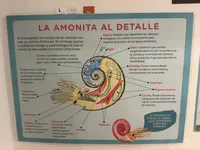
Inside an Ammonite
What Monquirasaurus Was: A Marine Reptile of the Mesozoic
Monquirasaurus was a pliosaur—an extinct marine reptile that lived during the Mesozoic era. Marine reptiles formed a highly specialized branch of the reptile family. Modern reptiles include turtles, crocodiles, lizards, snakes, and birds, and even dinosaurs were classified as reptiles. Scientists still debate which modern group Monquirasaurus is closest to, though it is probably nearer to lizards and snakes than to turtles, crocodiles, or birds. Like all reptiles, it breathed air through lungs, so even while living in the ocean it needed to surface regularly, much like whales and dolphins today.
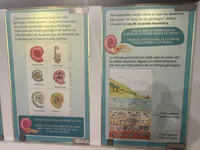
Ammonites and Geological Time
The Paja Sea: A Warm Cretaceous World Beneath the Waves
More than 115 million years ago, during the Early Cretaceous, the region of Monquirá lay beneath a warm, shallow body of water known as the Paja Sea, which may have been up to 200 meters deep. This marine environment hosted a rich variety of life, including marine reptiles and ammonites. When these organisms died, some of their remains settled in the seabed and were preserved as fossils, offering a window into this ancient underwater world.
Although most fossils from the area come from marine species of the Paja Sea, others include terrestrial plants and even fragments of a dinosaur from nearby land. These discoveries reveal how interconnected land and sea ecosystems were during the Cretaceous, and how both contributed to the fossil record of the region.
Although most fossils from the area come from marine species of the Paja Sea, others include terrestrial plants and even fragments of a dinosaur from nearby land. These discoveries reveal how interconnected land and sea ecosystems were during the Cretaceous, and how both contributed to the fossil record of the region.
First Peoples of South America and the Monquirá Region
The first humans reached the Cundiboyacense Plateau around 13,000 years ago, likely migrating south from North America along land routes. Another theory proposes an even earlier arrival by sea, entering the continent through its southern tip near present-day Argentina. These early groups lived as hunter-gatherers, relying on fishing, gathering fruits and roots, and hunting deer with tools made from stone and bone.
Over time, they adopted agriculture and began forming larger, more organized settlements. During this long process of movement and adaptation, these early peoples became the first humans to set foot in the region now known as Monquirá, the land surrounding present-day Villa de Leyva.
Over time, they adopted agriculture and began forming larger, more organized settlements. During this long process of movement and adaptation, these early peoples became the first humans to set foot in the region now known as Monquirá, the land surrounding present-day Villa de Leyva.
Why Scientific Names Look So Complex
Scientific names, such as Monquirasaurus, use Latin or Greek roots so each species has a unique, universally recognized name. These names always contain two parts: the genus (Monquirasaurus) and the species (Monquirasaurus boyacensis), the latter indicating where it was found. Its full scientific classification is:
• Kingdom: Animalia – animals
• Phylum: Chordata – animals with a backbone
• Class: Reptilia – reptiles
• Order: Plesiosauria – extinct marine reptiles
• Family: Pliosauridae – pliosaurs
• Genus: Monquirasaurus – reptile from Vereda Moniquirá
• Species: Monquirasaurus boyacensis – discovered in Boyacá
• Kingdom: Animalia – animals
• Phylum: Chordata – animals with a backbone
• Class: Reptilia – reptiles
• Order: Plesiosauria – extinct marine reptiles
• Family: Pliosauridae – pliosaurs
• Genus: Monquirasaurus – reptile from Vereda Moniquirá
• Species: Monquirasaurus boyacensis – discovered in Boyacá
From Sea Floor to Stone: How Fossils Slowly Form
Fossilization is the long natural process through which the remains of living organisms are preserved in rock. It begins in aquatic environments, where an animal’s body settles onto the sea floor and is quickly covered by soft sediment. As the soft tissues decay, only the hard parts—bones, shells, or teeth—remain, gradually buried under new layers of sediment.
Over millions of years, minerals infiltrate these hard structures, replacing their organic material and turning them into stone. As the surrounding sediments harden into rock, the fossil becomes sealed within. Eventually, erosion caused by wind, rain, and time wears away the overlying layers, bringing the fossil back to the surface. Once exposed, it can be recognized and carefully excavated, offering a rare window into ancient life.
Over millions of years, minerals infiltrate these hard structures, replacing their organic material and turning them into stone. As the surrounding sediments harden into rock, the fossil becomes sealed within. Eventually, erosion caused by wind, rain, and time wears away the overlying layers, bringing the fossil back to the surface. Once exposed, it can be recognized and carefully excavated, offering a rare window into ancient life.
Renaming Monquirasaurus: A New Identity for El Fósil
When this fossil was first discovered, it became known simply as El Fósil and was classified as Kronosaurus boyacensis, since it resembled the Australian pliosaur Kronosaurus. During the 2019 expansion of Museo El Fósil, the Museum, the Colombian Geological Survey, and Universidad de los Andes undertook new conservation and research efforts. Their studies revealed that the specimen belonged to a different animal altogether. Its updated scientific name, Monquirasaurus boyacensis, reflects both its unique identity as a fully Colombian marine reptile and honors the community where it was found: Vereda Monquirá in Boyacá.
Journey Into Deep Time: Humanity’s Brief Moment on Earth
Earth’s history stretches back 4.6 billion years—an almost unimaginable span compared to the roughly 300,000 years humans have existed. Even when translated into human lifetimes of 70–100 years, our presence is only a faint moment at the end of the geological clock. The Geological Time Scale, often shown as a spiral, captures this vast story: from the Cambrian explosion of life to the age of dinosaurs and the climate shifts of the Cenozoic, each era forms a layer in Earth’s long transformation. Our species appears only at the outer tip of this spiral, in the most recent sliver of planetary time.
Villa de Leyva, once covered by a prehistoric sea, preserves the traces of this ancient world in its surrounding geology. The region’s fossils remind us how profoundly Earth has changed and how brief human existence is when placed against millions of years of evolution and shifting environments.
Villa de Leyva, once covered by a prehistoric sea, preserves the traces of this ancient world in its surrounding geology. The region’s fossils remind us how profoundly Earth has changed and how brief human existence is when placed against millions of years of evolution and shifting environments.
Anatomy of Monquirasaurus, an Ancient Megapredator
Monquirasaurus had a streamlined, hydrodynamic body ideal for fast, powerful swimming. Its limbs were flattened into paddle-like flippers, similar to those of sea turtles and marine mammals, allowing agile movement through the water. Its most striking feature was its massive 2.7-meter head. The long jaws carried huge, pointed teeth built for piercing and gripping large prey—some nearly as long as a human forearm. Combined with its size and strength, these traits made Monquirasaurus one of the dominant predators of its ancient marine world.
Geological Time Scale: Eons, Eras, and Periods at a Glance
A simplified view of Earth’s major eons, eras, and periods shows how life and environments evolved across immense stretches of time. The table below lists major divisions and their approximate ages in millions of years.
Eon Era Period Approx. Age (million years ago)
---------------------------------------------------------------------------
Phanerozoic Cenozoic Holocene 0.01
Phanerozoic Cenozoic Pleistocene 2.6
Phanerozoic Cenozoic Pliocene 5.3
Phanerozoic Mesozoic Cretaceous 145
Phanerozoic Mesozoic Jurassic 201
Phanerozoic Mesozoic Triassic 252
Phanerozoic Paleozoic Permian 299
Phanerozoic Paleozoic Carboniferous 359
Phanerozoic Paleozoic Devonian 419
Proterozoic Proterozoic Neoproterozoic 1000
Proterozoic Proterozoic Mesoproterozoic 1600
Archean Archean Archean 2800
Hadean Hadean Hadean 4000
Eon Era Period Approx. Age (million years ago)
---------------------------------------------------------------------------
Phanerozoic Cenozoic Holocene 0.01
Phanerozoic Cenozoic Pleistocene 2.6
Phanerozoic Cenozoic Pliocene 5.3
Phanerozoic Mesozoic Cretaceous 145
Phanerozoic Mesozoic Jurassic 201
Phanerozoic Mesozoic Triassic 252
Phanerozoic Paleozoic Permian 299
Phanerozoic Paleozoic Carboniferous 359
Phanerozoic Paleozoic Devonian 419
Proterozoic Proterozoic Neoproterozoic 1000
Proterozoic Proterozoic Mesoproterozoic 1600
Archean Archean Archean 2800
Hadean Hadean Hadean 4000
El Fósil Community MuseumMuseo comunitario El Fósil
Villa de Leyva (founded on 12 June 1572) is often imagined as Colombia’s highland time capsule, where whitewashed walls and a vast stone plaza slow the day to a measured, colonial rhythm. Set in the dry, open landscapes of Boyaca, it feels both composed and slightly otherworldly on arrival, with a clarity of light that sharpens facades, doorways, and the quiet geometry of its streets. Yet the town’s identity is not only architectural: the surrounding hills hold a much older story, and local life has learned to read the land as carefully as the built past. That sense of layered time—Spanish-era order above, deep geology below—gives Villa de Leyva a distinctive calm, as if history here is something you can feel underfoot as much as see.
Explore by type and place