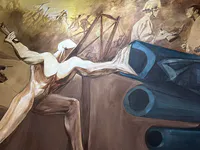
El pueblo en lucha
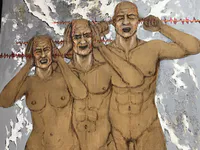
Silenced by Pain
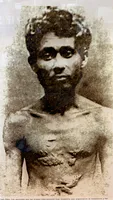
Cayo Báez after Torture
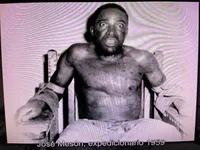
José Mesón After Torture
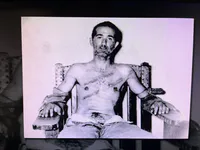
Miguel Álvarez Fadul After Torture
Inside La 40: A Survivor’s Account of Torture and Terror
The night I arrived at the torture center, it seemed like something out of a Dantean hallucination. Torture took place throughout the prison courtyard and its rooms, amid a bestial frenzy. Guards and naked, handcuffed men mingled, screaming and writhing like decapitated chickens. Even the calmest person would struggle to witness a defenseless man reduced to lacerated flesh, his body covered in black, bleeding welts from more than two hundred lashes with whips, thick wires, and plastic tubing—a kind of bipedal zebra.
The screams caused by electric shocks were especially wavering and wrenching, as the burning current ran through the nervous system. A naked man strapped to a chair covered with copper plates twisted violently under the shocks, his body contracting and his face contorting between cries of pain. It was an unbearable sight. During pauses, the torturers traded jokes and sarcastic remarks at the victims’ expense, while repeatedly snuffing cigarettes against the bodies of men bound in La Silla. When someone fainted from beatings in a ring called El Coliseo, two or three guards at a time struck the captive’s raw, flayed flesh. A can of salt water was then poured over him, or he was placed in La Silla and revived with electric shocks.
A powerful spotlight produced a blinding glare that seemed to burn into the brain, even with eyes closed, as the interrogation continued. El Coliseo was also used to set two trained dogs on the captive, who was always naked and handcuffed. The dogs attacked intermittently, with pauses of thirty seconds to a minute. During each pause, the interrogators resumed their questioning, then signaled the dogs to attack again. The dogs obeyed both commands automatically, attacking and stopping on cue. It was a system of physical and psychological torture: the dogs stayed practically on top of the victim, growling as they waited for the next signal.
Electric tubes applied to vital areas were common, but the worst part of this infernal catalog was not the torment each person endured. At a certain point, pain plunges a person into a fog, a half-conscious state in which the mind goes blank, fainting occurs, and a strange numbness sets in. More unbearable than one’s own punishment is witnessing—or hearing—the torment inflicted on others.
—Rafael Valera Benítez
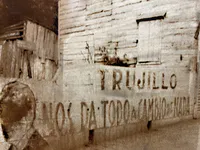
Trujillo’s Cult of Gratitude
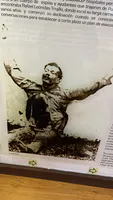
Fallen Anti-U.S. Fighter
Economic Power and Monopoly Under Trujillo’s Dictatorship
Under Rafael Trujillo’s dictatorship, the limited industrial development of the Dominican Republic was systematically monopolised by the dictator, his associates, and his family. State institutions—including the army, police, and security services—were placed at the service of their economic interests. As historian Juan Bosch observed, Trujillo turned himself by force into the great captain of national industry.
At the time of his death, Trujillo controlled about 51% of all industrial capital in the country. His personal fortune included factories, plantations, vast cattle ranches, sugar mills, airlines and shipping companies, and large bank deposits. It was estimated at over 600 million U.S. dollars of that period—equivalent to more than three billion today. For comparison, in 1960 a four-door Chevrolet automobile cost around one thousand pesos.
At the time of his death, Trujillo controlled about 51% of all industrial capital in the country. His personal fortune included factories, plantations, vast cattle ranches, sugar mills, airlines and shipping companies, and large bank deposits. It was estimated at over 600 million U.S. dollars of that period—equivalent to more than three billion today. For comparison, in 1960 a four-door Chevrolet automobile cost around one thousand pesos.
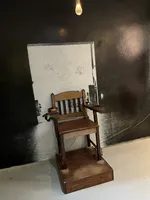
The Throne Torture Chair
Memorial Museum of the Dominican ResistanceMuseo Memorial de la Resistencia Dominicana
The museum grew from families’ efforts to preserve the belongings and testimonies of people who resisted political repression. It opened in 2011, documenting struggles from the U.S. occupation beginning in 1916 through Trujillo’s dictatorship and the repression of Joaquín Balaguer’s twelve-year rule, ending in 1978. Personal objects, photographs, and survivor accounts connect political history with imprisonment, exile, and loss, giving victims and resistance movements a central place in the country’s historical record.
Explore by type and place