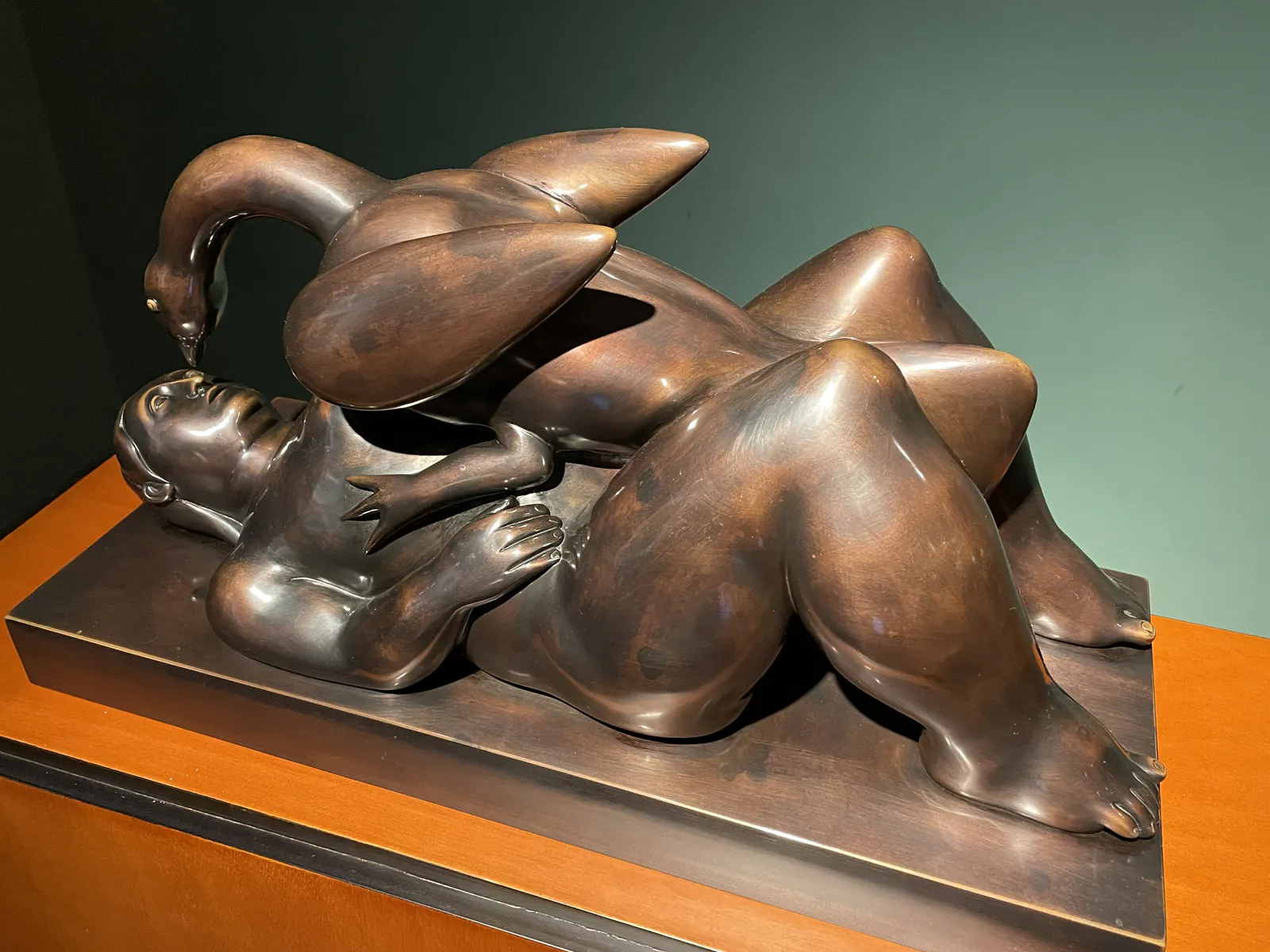
Leda and the Swan
Fernando Botero
This 1996 bronze sculpture reinterprets the myth in which Zeus, king of the gods, seduces or assaults Leda, Queen of Sparta, in the form of a swan. From their union, according to legend, were born Helen of Troy and other heroic figures. Botero’s voluptuous forms soften the myth’s violence, transforming it into a surreal, sensual tableau. His signature style invites reflection on desire, divinity, and the boundary between seduction and power.
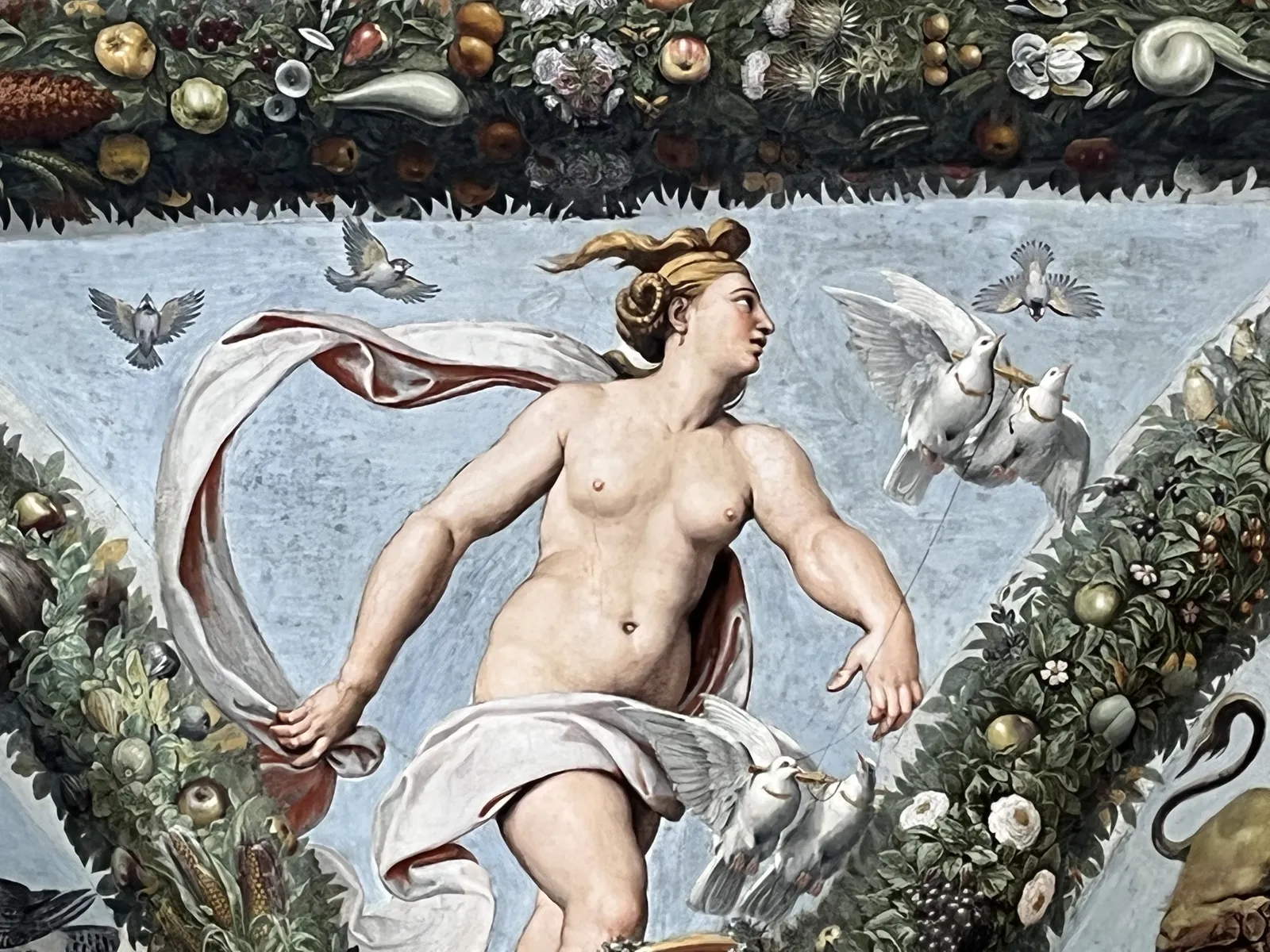
Venus and the Doves
Raphael
In this fresco (1518), Raphael presents Venus, goddess of love, gracefully accompanied by doves, her sacred birds. The flowing ribbon emphasizes her divine beauty and motion, while the doves allude to purity and erotic desire. The image echoes Venus’ central role in the myth of Cupid and Psyche, where love governs both divine and mortal fates.
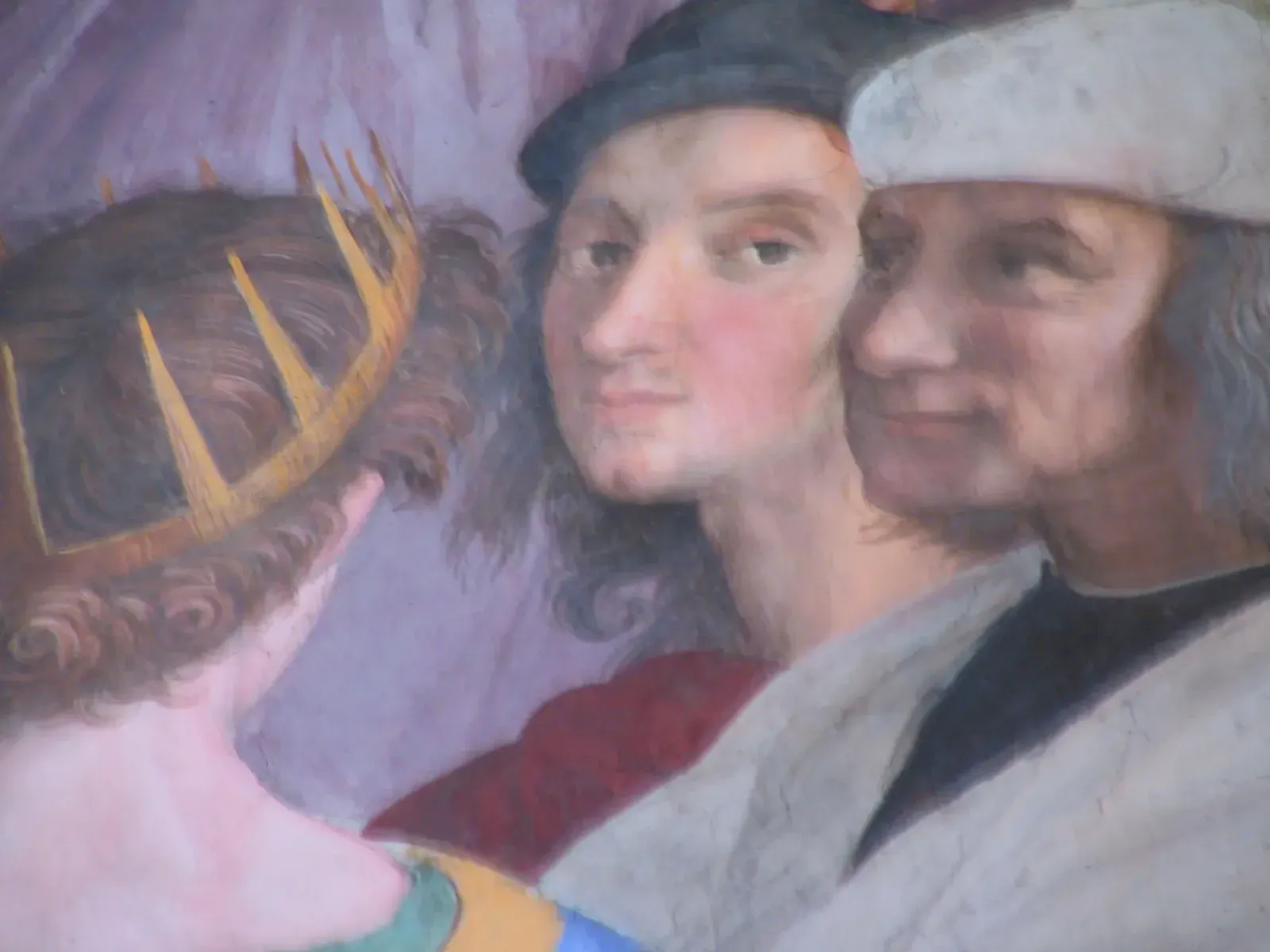
Raphael and Perugino (detail)
Raphael
This section of The School of Athens (1509-11) features a rare self-portrait of Raphael (center) alongside his teacher Perugino (right). Originating from the Italian High Renaissance, the work subtly inserts the artist into the legacy of classical knowledge, aligning painters with philosophers as bearers of intellectual ideals.
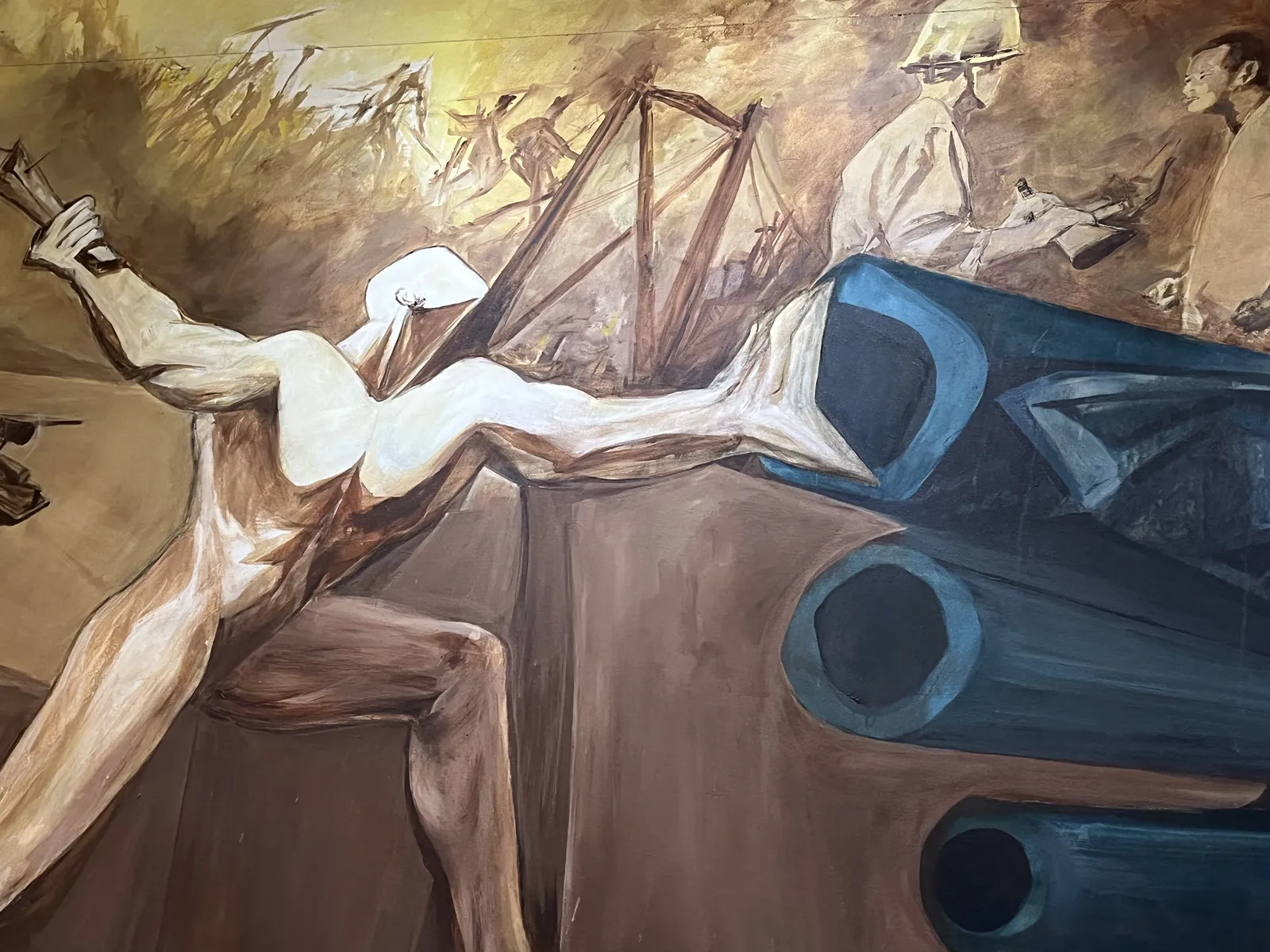
El pueblo en lucha
Ramón Oviedo
This mural (2013) shows a bound, faceless figure hurling itself toward the dark mouths of cannons, while ghostly soldiers and crowds emerge in the background. The scene recalls the Dominican struggle against dictatorship and foreign intervention in the 20th c. By fusing a single straining body with collective, blurred forms, Oviedo concentrates individual sacrifice into a broader history of resistance.
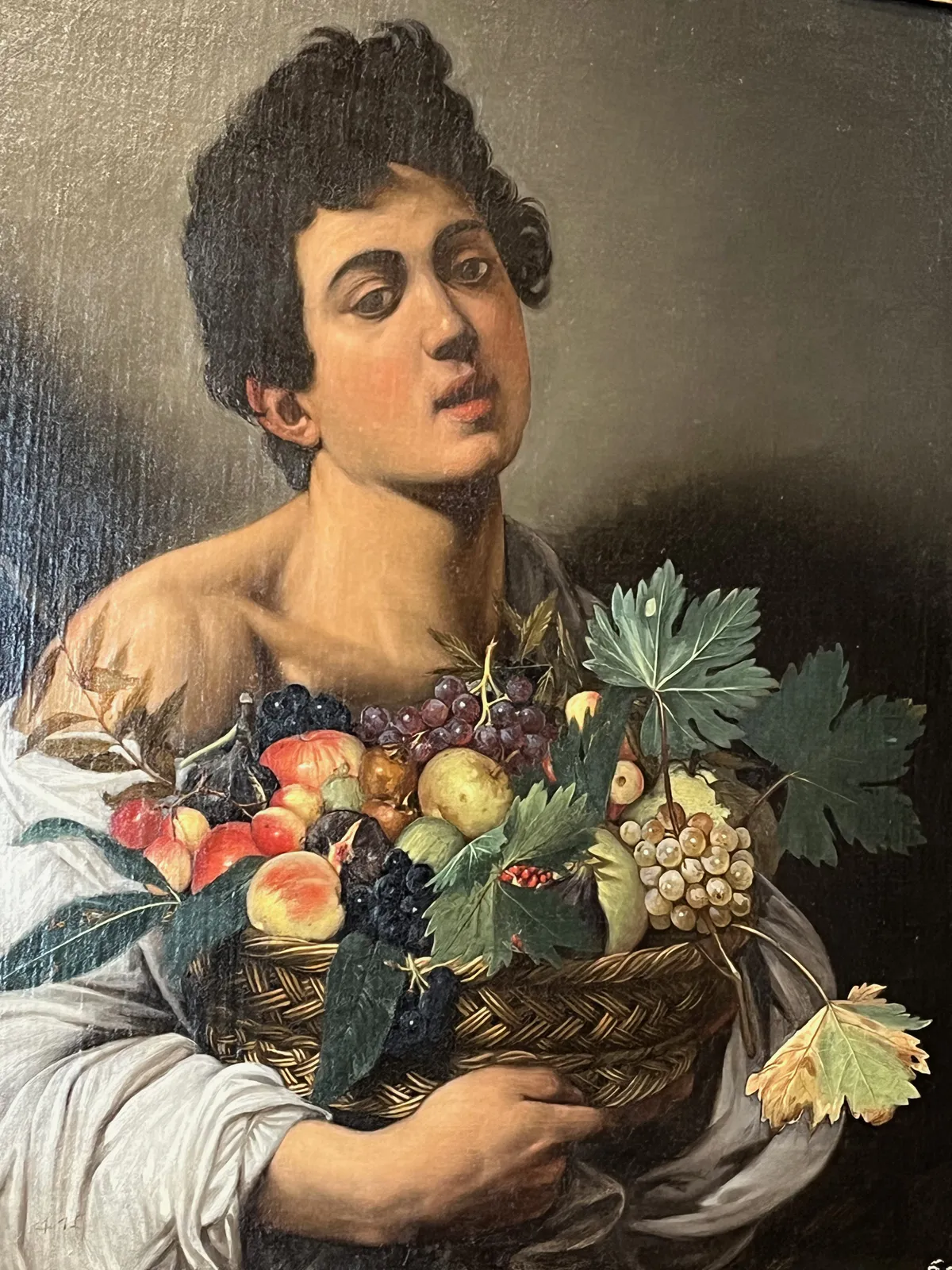
Boy with a Basket of Fruit
Caravaggio
This early Baroque painting (c. 1593) merges portraiture with still life, showing Mario Minniti holding a basket of overripe fruit. Caravaggio renders blemishes and textures with unflinching realism. The sensual posture and decaying abundance evoke themes of youthful beauty, ephemerality, and temptation.
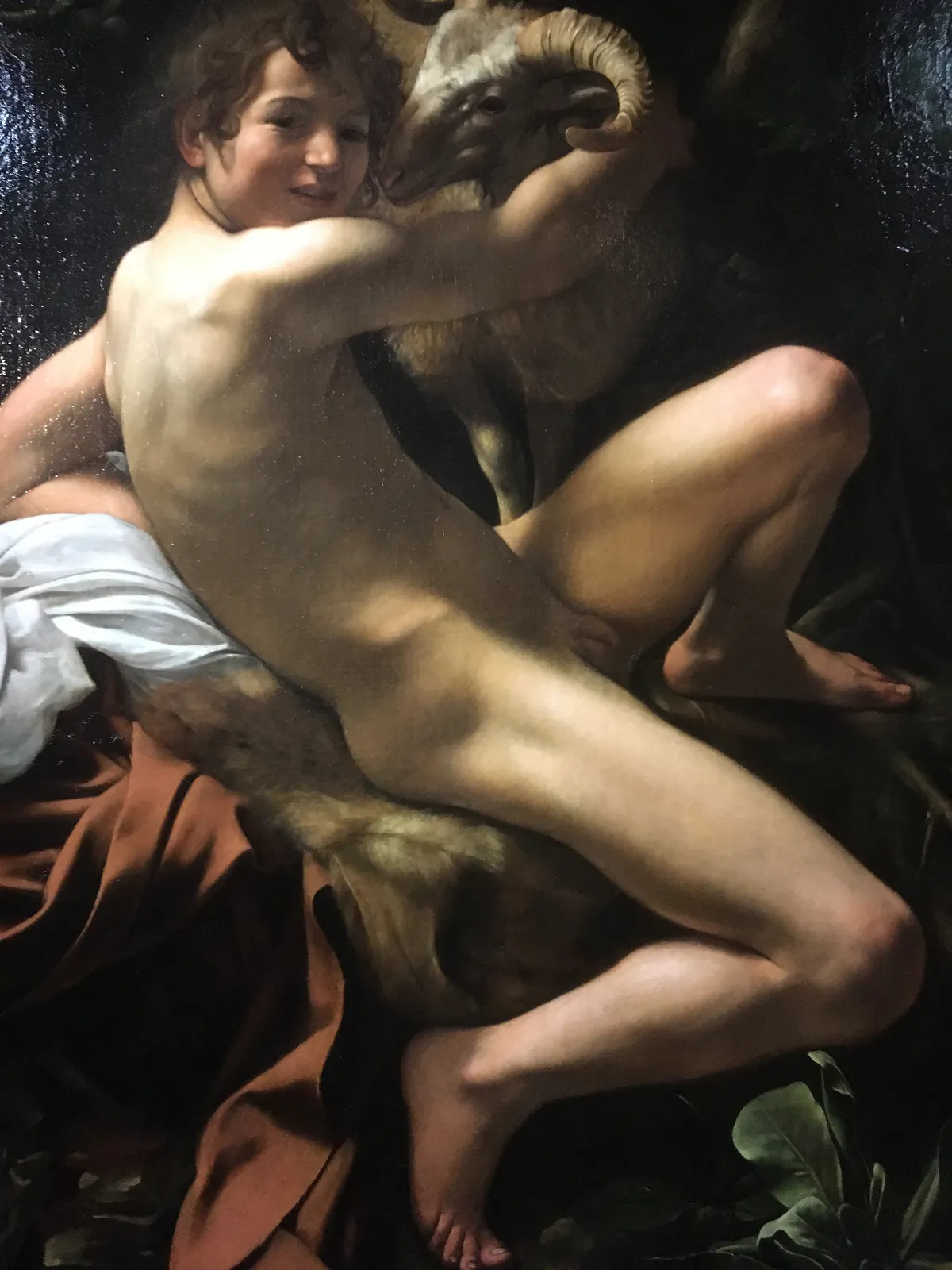
John the Baptist (Youth with a Ram)
Caravaggio
Painted around 1602, this work portrays John the Baptist as a youthful figure embracing a ram. Caravaggio departs from solemn prophecy to present vitality, sensuality, and human immediacy. The saint’s glance engages the viewer, while the animal evokes sacrifice and redemption. Through natural light and unidealized form, the painting fuses biblical meaning with raw, earthy presence.
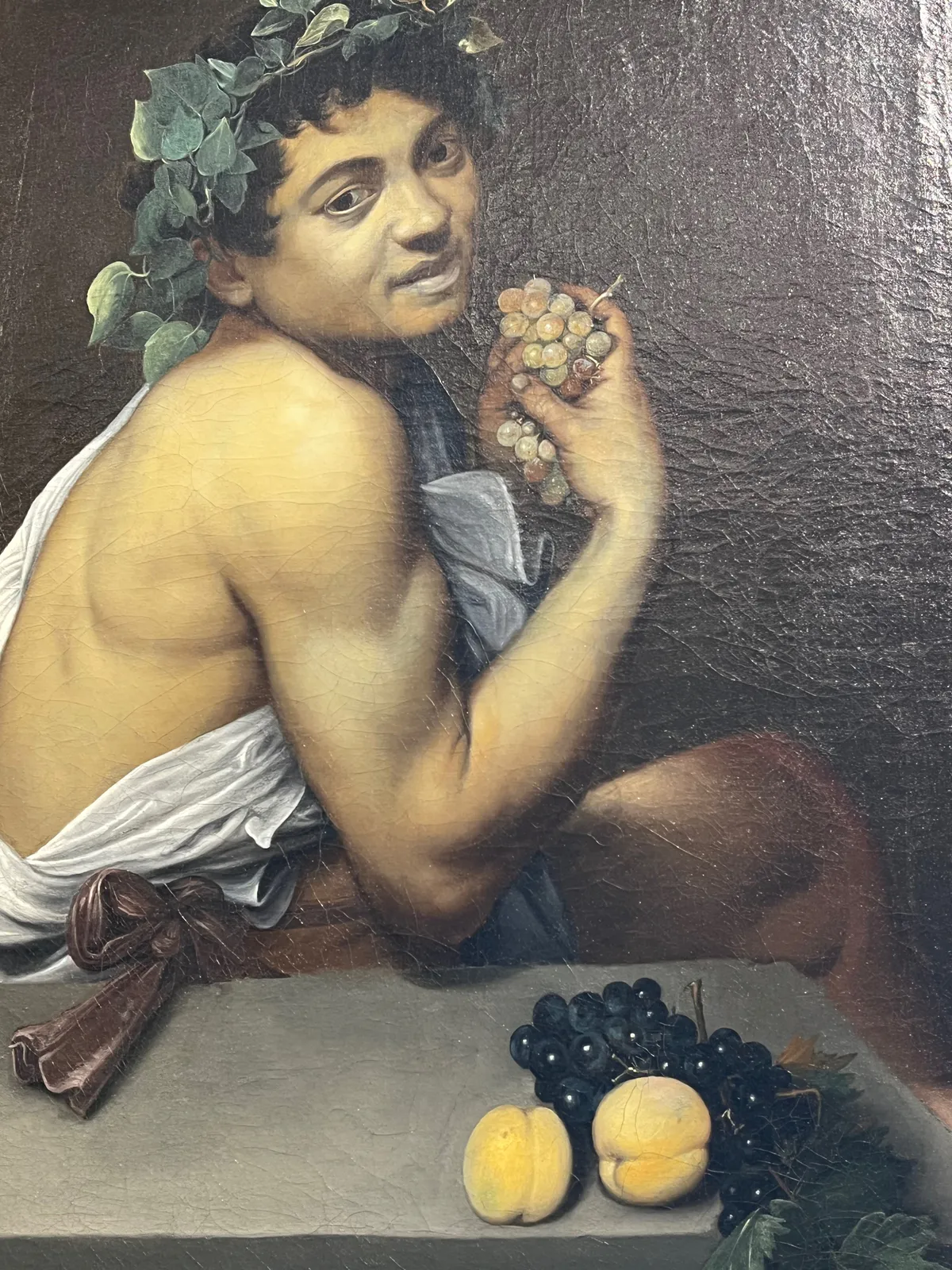
Young Sick Bacchus
Caravaggio
This self-portrait (c. 1593) shows Caravaggio as Bacchus with jaundiced skin and tense features, painted while recovering from illness. The ivy crown replaces the usual vine leaves, subverting divine idealism. Both sensual and unsettling, the image mocks classical beauty and reveals the artist’s own physical vulnerability.
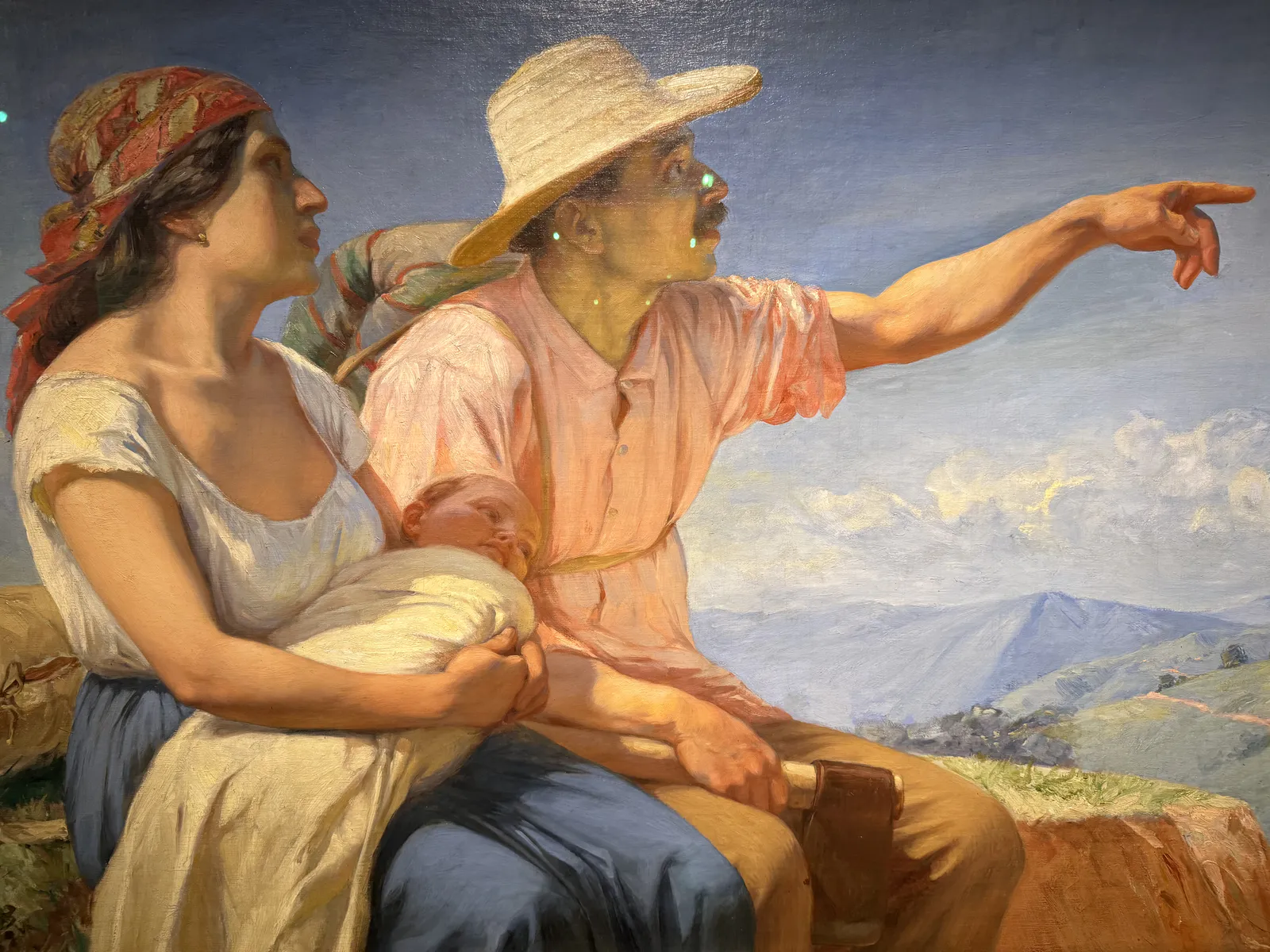
Horizons
Francisco Antonio Cano
Horizontes (1913) presents an idealized vision of Colombia’s settler frontier. The man's outstretched arm signifies hope and destiny, while the woman and child convey continuity and rootedness. This work by a leading Colombian academic painter uses the peasant family to symbolize national identity and the forging of a future in the Andean landscape.
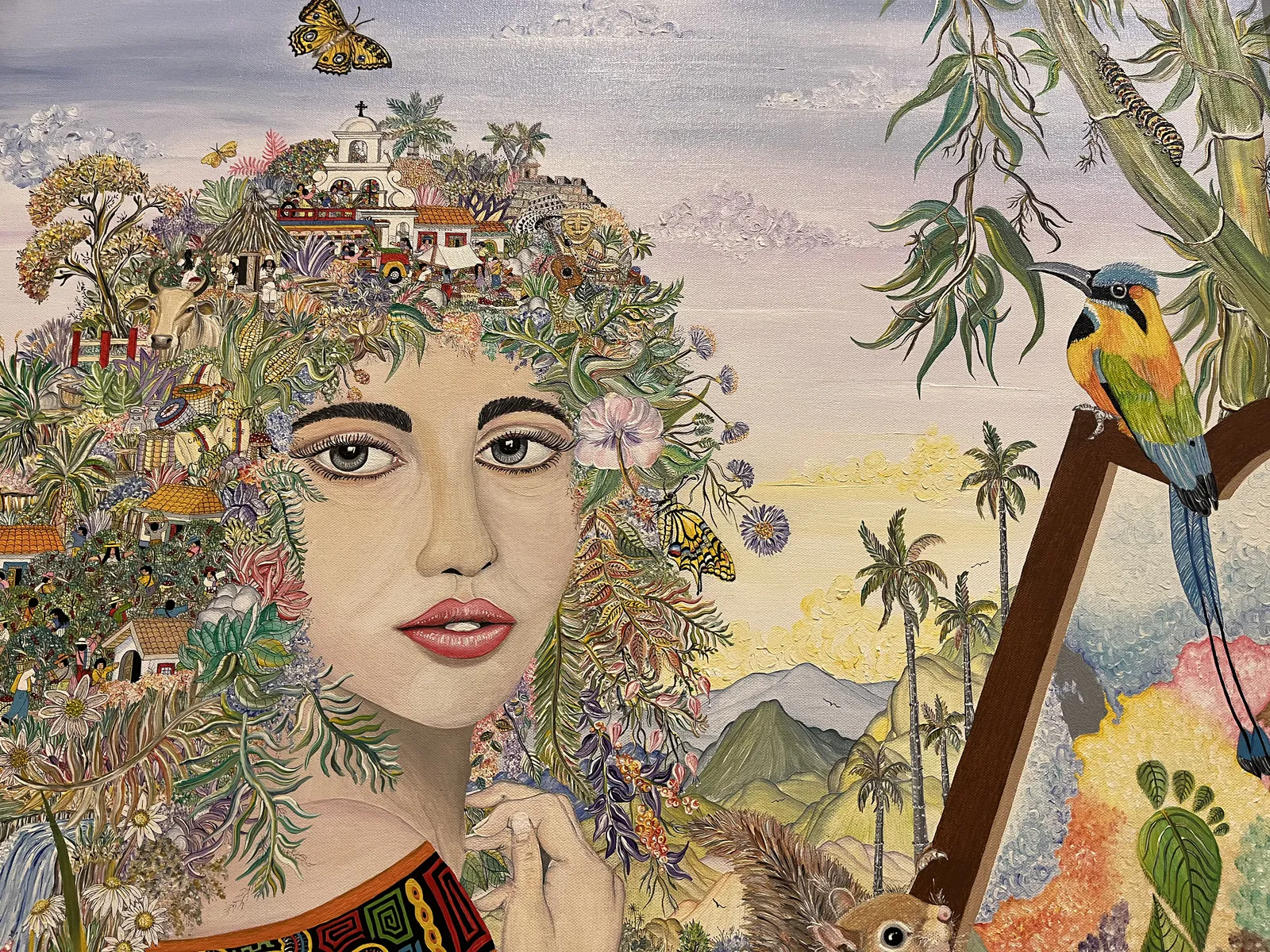
Aún Hay Tiempo
Julio César Ojeda Ariza
This 2021 work blends oil and ink to portray a woman whose hair becomes a lush tapestry of biodiversity and rural life. Symbolizing Colombia’s natural and cultural abundance, it warns of its fragility. The title, There’s Still Time, urges collective action to preserve the environment and ancestral wisdom.
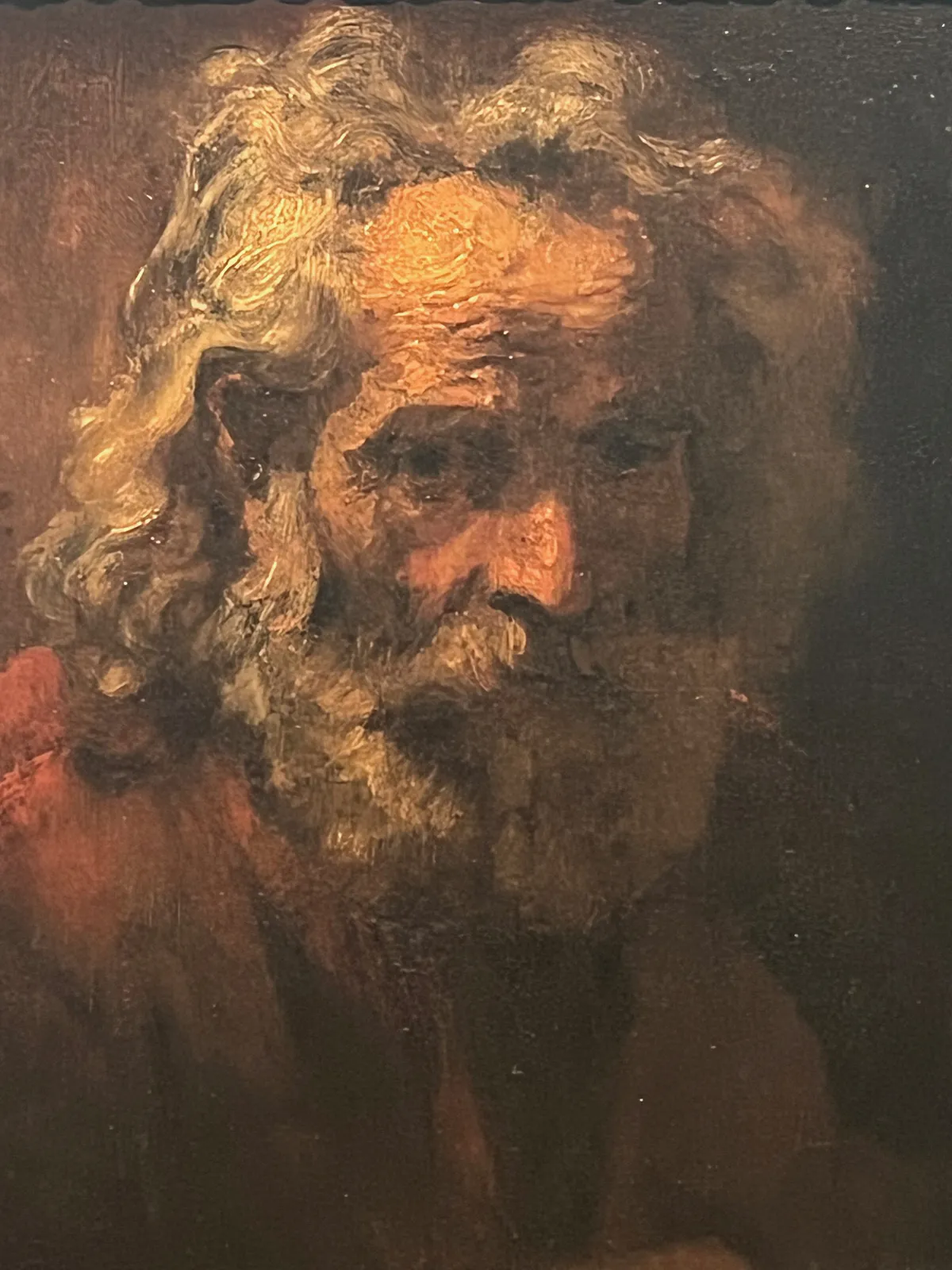
Bust of a Bearded Old Man
Rembrandt
This painting (c. 1630) by Rembrandt van Rijn exemplifies the tronie genre, focusing on character over identity. The expressive face of the elderly man, rendered in oil on panel, showcases Rembrandt’s mastery of light and shadow. As one of his smallest works, it explores themes of old age, capturing the nuances of human expression and emotion, marking an early exploration of the artist’s fascination with the human condition.
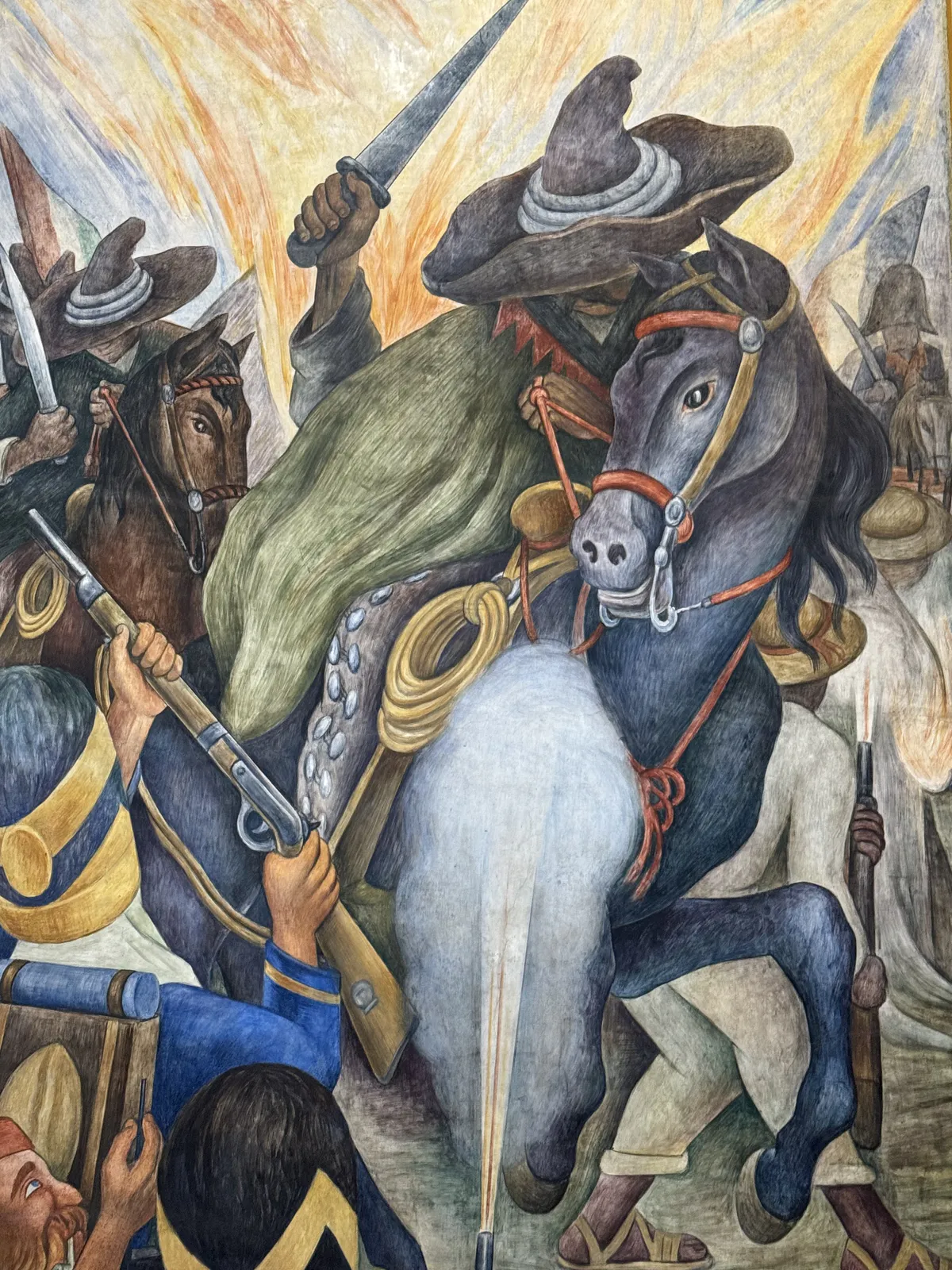
The Legend of Agustín Lorenzo (detail)
Diego Rivera
This 1936 fresco dramatizes the legendary outlaw Agustín Lorenzo as a symbol of resistance. Armed revolutionaries clash with government forces, their horses rearing amid smoke and flames. Rivera fuses myth and history, casting Lorenzo as a Mexican Robin Hood whose defiant struggle against injustice became folklore in the national imagination.
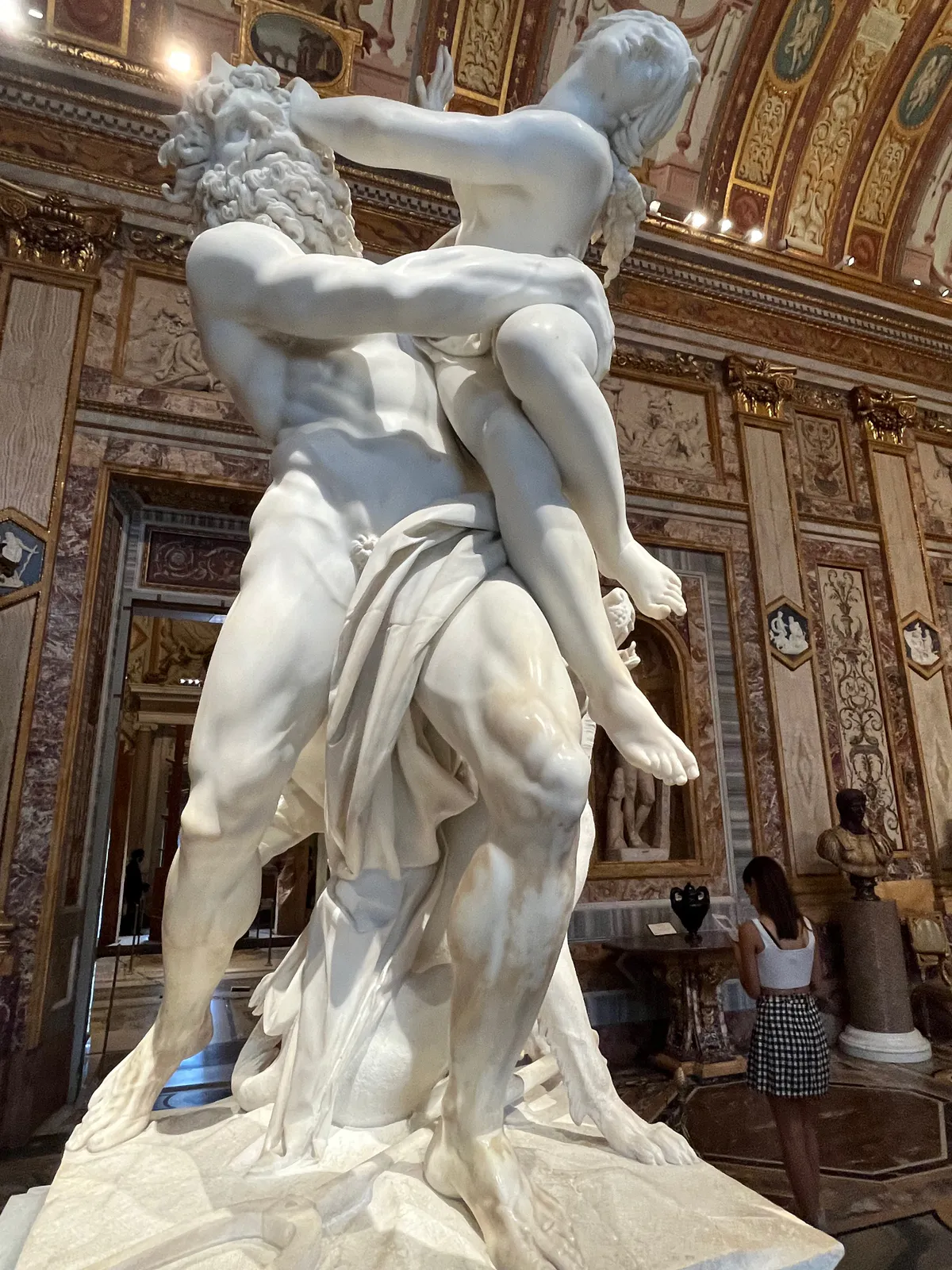
The Rape of Proserpina
Gian Lorenzo Bernini
From this angle, Bernini’s technical genius is apparent. Pluto’s gripping hands sink into Proserpina’s flesh with astonishing realism, turning marble into living form. The work (1621–22) stages emotional and physical tension at its peak, embodying the Baroque goal of stirring awe, drama, and pathos in a single breathtaking moment.
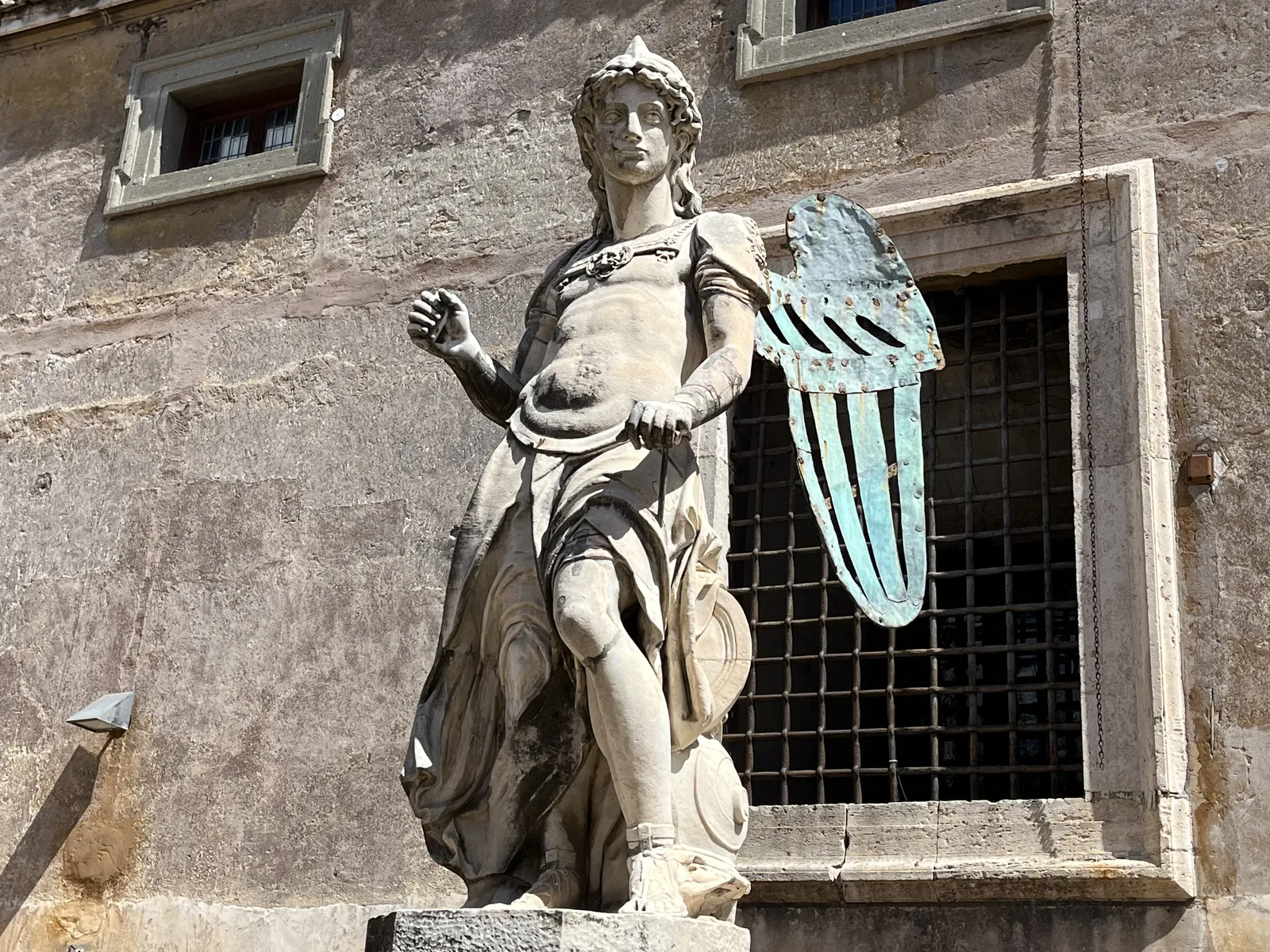
Archangel Michael
Raffaello da Montelupo
This marble statue (1544) once crowned the fortress, showing the Archangel Michael in the moment of sheathing his sword after ending the plague of 590. The figure’s contrapposto stance and idealized anatomy recall classical sculpture, while the raised wings and military dress assert his role as heavenly protector. The blend of antique form and Christian subject turns a local miracle into a civic symbol of deliverance.
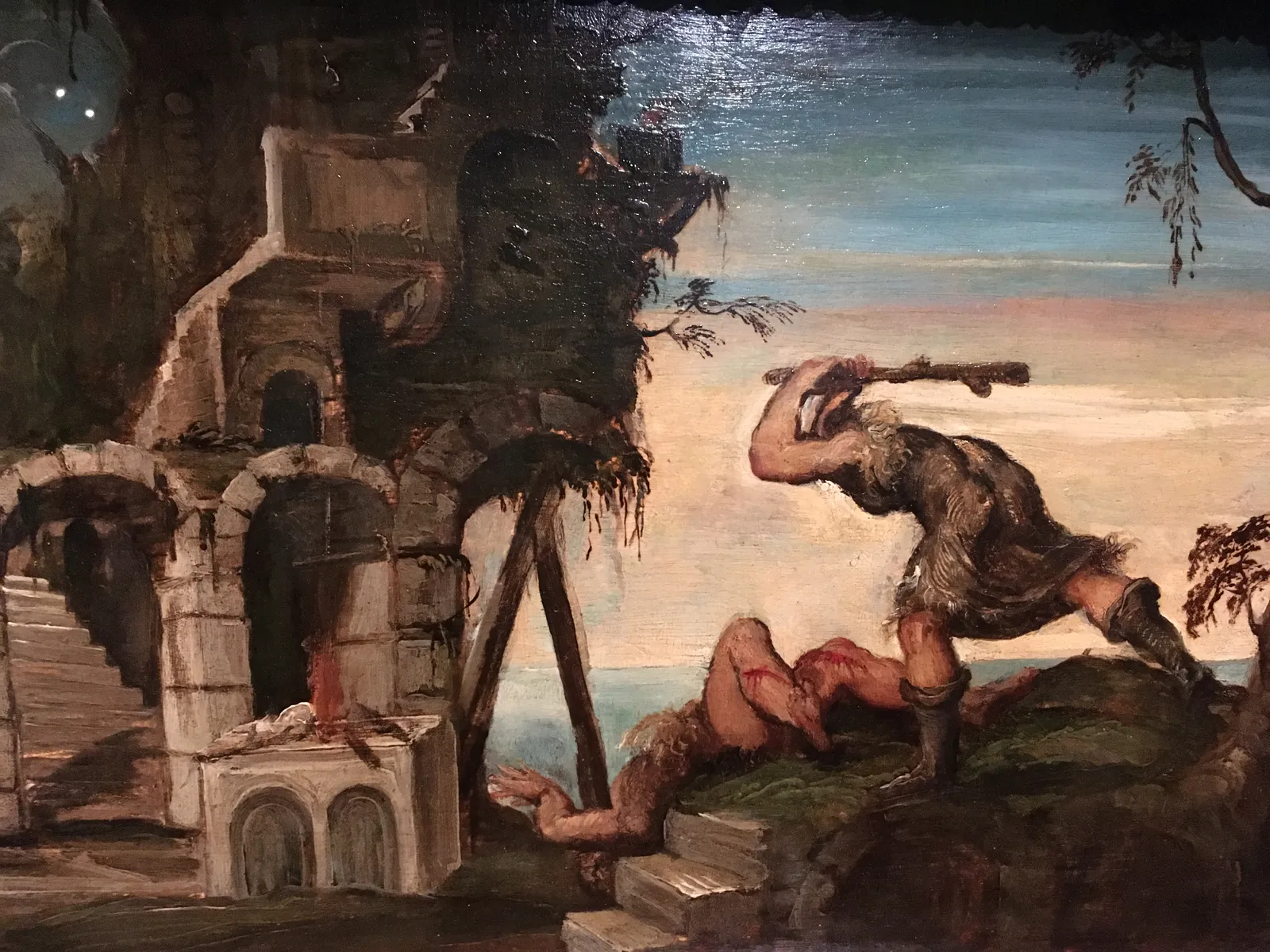
Cain and Abel
Tintoretto
The scene (1550–53) shows the biblical story of Cain’s jealousy and the murder of his brother Abel. The work reflects the Mannerist style through sharp contrasts of light and shadow, twisting poses, and tense, compressed space. Tintoretto’s hallmark energy appears in the sweeping gestures and urgent brushwork that heighten the scene’s violence, underscoring the enduring power of biblical themes in Renaissance art.
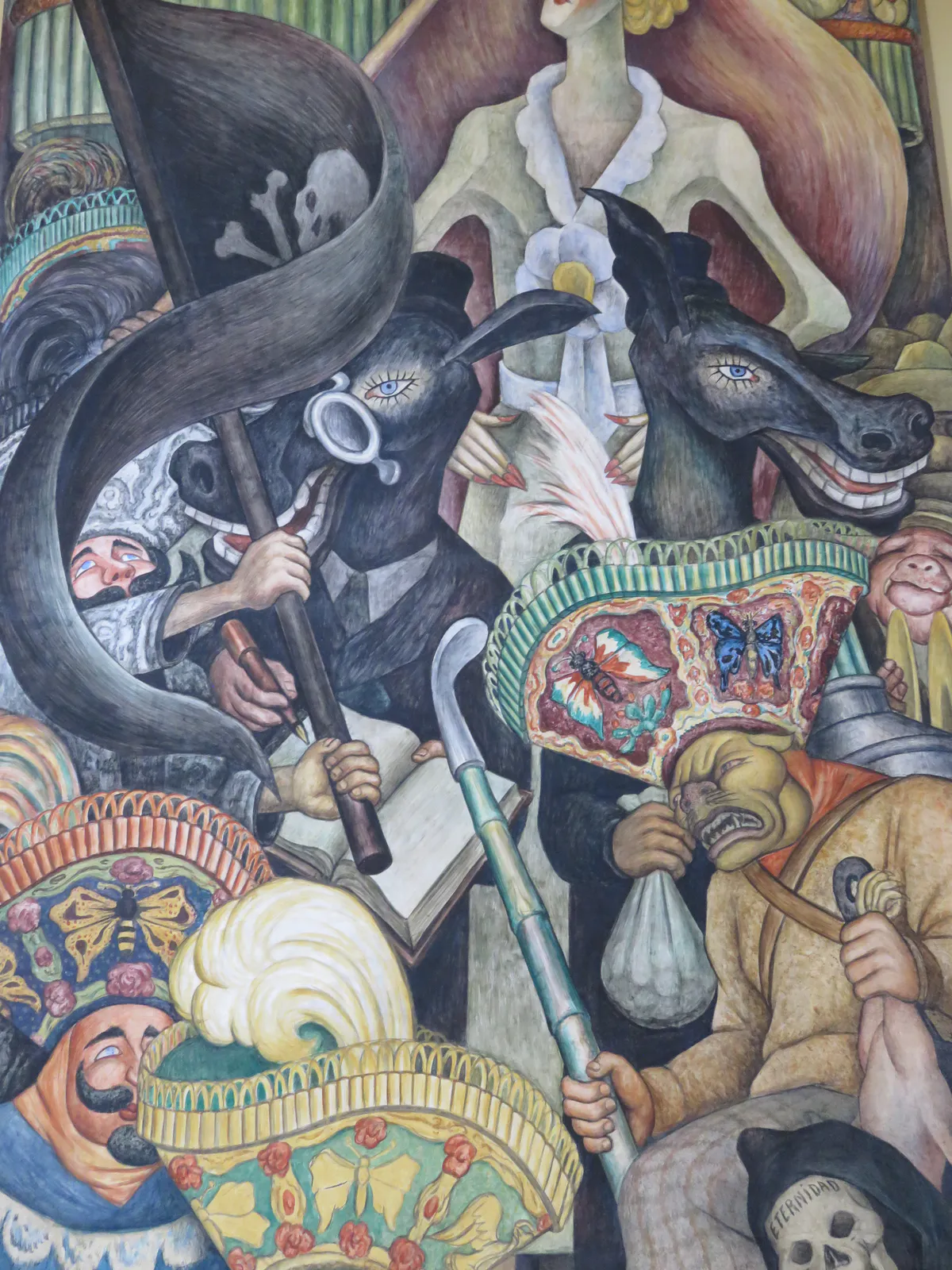
Carnival of Mexican Life (detail)
Diego Rivera
This scene from Carnival of Mexican Life (1936) mocks imperial and capitalist excess. Donkey-headed elites, masked peasants, and a skull-emblazoned flag form a surreal parade of corruption and resistance. Drawing on the Carnival of Huejotzingo, Rivera fuses satire, folk ritual, and political critique to expose social hypocrisy.
“When the path is beautiful, do not ask where it leads.” — Zen proverb
Welcome to my travel photography!
“When the path is beautiful, do not ask where it leads.” — Zen proverb
Welcome to my travel photography!
For as long as I can remember, my path has been one of discovery—seeking beauty, timelessness, and connection in every corner of the world. It has also been a journey of deep learning and understanding. I’ve been an avid traveler (or perhaps a travel addict?) for most of my life. My love for travel began long before I ever left home: as a child, I drew a fantasy map of my grandparents’ apartment and “traveled” through it with my cousin Sonya, imagining adventures in every corner. Nearly 90 countries and countless moments of awe later, I’m excited to share this journey with you.
Thanks to the tireless and ingenious programming of Diagilev, we’re now able to present about fifteen percent of the images I’ve accumulated over the years. More will be released in small batches depending on your interest. While the first release leans toward museum photography, later ones will include more nature, architecture, culture, and general travel experiences. If you’d like to receive email notifications about new releases, feel free to reach out—no commercial use, ever.
Throughout my travels, I’ve been drawn to two intertwined kinds of discovery. One is intellectual: learning why the world is the way it is. History became my guide, shaping my perspective and filling my camera roll with museums and old buildings. To me, history is not the past—it is the key to understanding the present and how the world became what it is. The other is emotional: seeking moments of elevation—spirituality, beauty, harmony—often found in nature, monasteries, and ancient sacred spaces. Together, these impulses shape my photography. It invites you to learn, admire, and soar—to rise above the mundane and see the world through a lens of curiosity and wonder.
Much of my later travel became possible thanks to my job with Delta Air Lines, but the wanderlust began years earlier. By the time I joined the industry, I had already visited over 35 countries and lived in several—largely thanks to a backpacking journey around the world with Luis León, whose face appears in many early photos. I grew up in Ufa in the USSR, and since leaving it I have lived, studied, and worked in Latvia, the United States, France, South Korea, Canada, Spain, Italy, Brazil, Japan, and Colombia.
A life of near-constant movement may seem a little crazy, but it has deepened my understanding of the world and produced the photography you are about to see. Over the years, my style has evolved—more intentional, more refined—yet its core remains the same: a search for understanding, timeless beauty, and a connection to those who walked this earth long before us.
I hope these photos stir something in your soul, just as they did in mine. I’d love to hear from you—whether reactions, suggestions, corrections, or a request to be added to the email list for new releases (no commercial use, I promise). You can learn more about my travels here, and my academic life here.
Enjoy our shared journey!