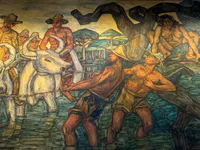
Struggle for the Land
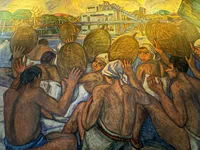
Toward Banco Popular
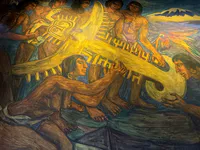
Legacy of the Ancestors
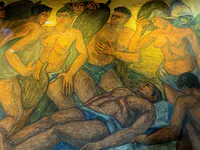
Fallen Worker
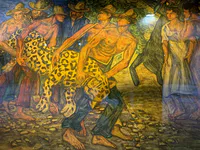
The Jaguar of the Forest
Fresco Mural Painting: Technique, Space, and Memory
Fresco mural painting is one of the most demanding forms of art because of its technical complexity, monumental scale, and humanistic themes. Pigments are applied directly onto fresh plaster, requiring precise timing and planning, and turning the wall itself into the support for the image. Historically, frescoes have served as public narratives of decisive episodes in the life of societies, preserving their collective memory on a grand scale. A mural is never independent from the space it occupies: it accentuates, completes, and names the architecture that surrounds it. In this way, mural painting transforms corridors, plazas, and public buildings into places where history, identity, and daily life intersect.
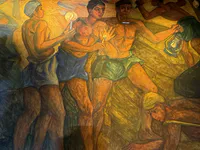
The Light of Labor
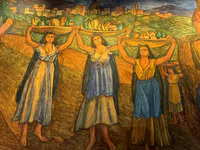
Women of the Harvest
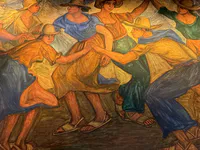
The Circle Dance
Pedro Nel Gómez Murals
The fresco cycle commissioned in 1956 for the main hall of Banco Popular de Medellín was relocated in 1988, when construction began on Parque Berrío station. Rather than consign the paintings to storage, the Medellín Metro incorporated them into a pedestrian passage that opened in 1996, linking Plazuela Nutibara with Parque Berrío. Their humanist themes and commanding scale turn an everyday shortcut into a shared civic gallery.
Explore by type and place