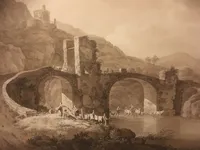
Italian Landscape with Bridge
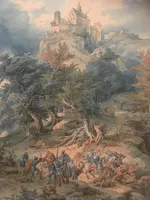
Medieval Knights’ Battle at Wartburg Castle
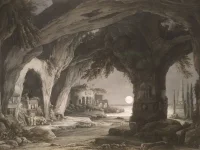
Landscape with Cave, Tombs, and Ruins by Moonlight
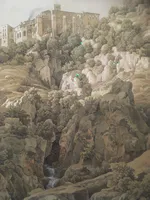
Benedictine Convent of Santa Scholastica
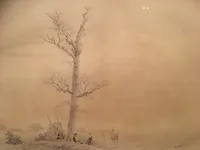
Autumn Evening on the Lake
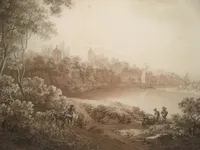
Riverscape with Figures and Carriage
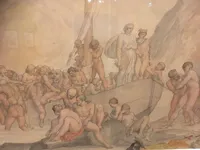
The Souls on the Styx
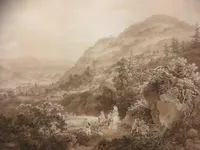
View Towards Karlsbad in Bohemia
From Classicism to Romanticism in German Art
Around 1800, several artistic currents flourished side by side in the German-speaking lands, all shaped by a renewed fascination with the past. Neoclassicism looked back to the world of Mediterranean antiquity, taking its ideals of harmony, clarity and proportion from Greek and Roman art. Romanticism, by contrast, found inspiration in the Middle Ages, in northern legends and in works such as The Songs of Ossian, presented as poems by a 3rd-century Scottish bard but later revealed as an 18th-century literary fabrication.
Johann Wolfgang von Goethe, a passionate admirer of classical art after his travels in Italy, played a key role in promoting a taste for the Antique in Germany. In a politically fragmented region, this shared admiration for classical antiquity offered a cultural ideal that many hoped could serve as a unifying thread.
Johann Wolfgang von Goethe, a passionate admirer of classical art after his travels in Italy, played a key role in promoting a taste for the Antique in Germany. In a politically fragmented region, this shared admiration for classical antiquity offered a cultural ideal that many hoped could serve as a unifying thread.
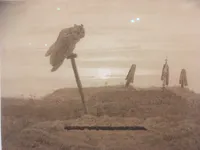
Owl on a Grave
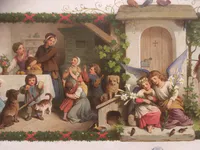
Lunch Hour
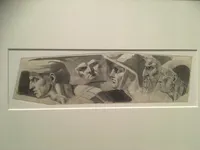
Studies of Male Heads
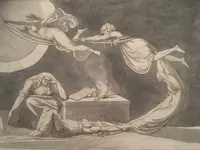
Incantation Scene with Witch
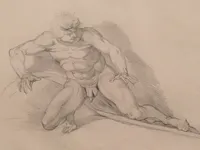
Study of a Male Nude
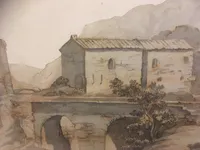
Italian Landscape
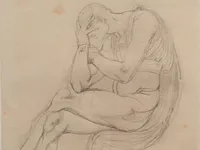
Young Man Hiding Face in Hand
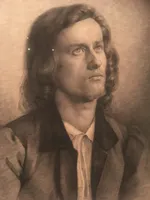
Bust Portrait of a Young Man
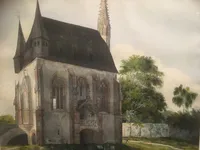
St Michaels Chapel in Kiedrich
Romantic Germany: Drawings from the Museums of WeimarAllemagne romantique : Dessins des musées de Weimar
Romantic Germany: Drawings from the Museums of Weimar, shown at the Petit Palais, draws on Weimar’s storied collections to trace German draftsmanship around 1770–1840, when Enlightenment classicism and Romantic inwardness overlapped. Across studies and finished sheets, artists measure the antique ideal championed by Goethe against medieval revival, northern legend, and the charged atmosphere of Songs of Ossian. In a politically fragmented land, the exhibition casts Weimar as a cultural workshop where line and paper became tools for memory, emotion, and emerging identity.
Explore by type and place