2023 © Maxim Tabachnik
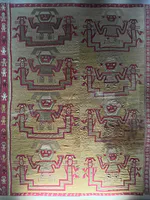
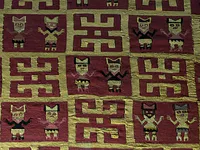
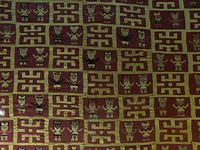
In Asia, China stands out for the discovery of silk and the creation of a major trade route based on this fabric. For a long period, silk production was a tightly guarded state secret, and fragments found in tombs from the Shang dynasty date silk use between the 11th and 7th cc. BC. In India, cotton textiles were already being woven by about 1,750 BC, and cotton plants from India and Africa later spread throughout the Old World. In Japan, textile production likely developed between the 4th and 1st cc. BC, alongside the formation of an agrarian culture. By the 4th–6th cc. AD, silk textiles with woven designs appear, reflecting growing influence from China and the gradual refinement of weaving techniques.
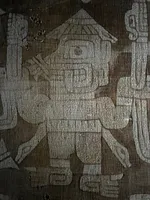
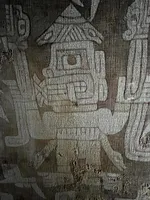
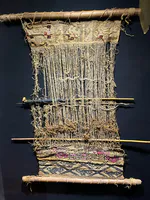
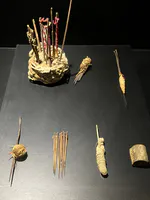
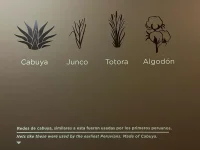
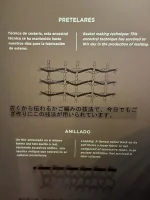
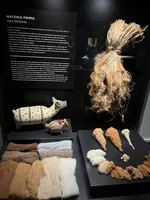
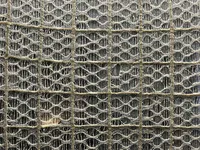
Peruvian textile making developed from rope making, mat weaving, and basketry. Evidence shows the use of rushes for basket weaving about 10,000 years ago and cotton around 7,000 years ago. From these early tubular strips and later cotton threads grew a rich textile tradition. Around 4,500 years ago, more efficient production methods, abundant resources, and expanding trade networks led to technological advances, new forms of artistic expression, and specialized knowledge of ecosystems and plants. During this time, techniques such as interweaving, netting, braiding, looping, and knotting were developed; knotting used a single thread with knots forming a mesh, mainly for making nets.
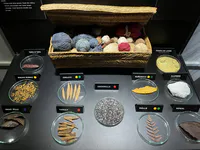
Common colors include brown, reddish-orange, purple-brown, olive green, and turquoise green; some textiles also show resist-dye techniques and intense blue dyes. These mineral, plant, and animal-based dyes decorated textiles that likely served as tools of religious indoctrination or temporary ceremonial garments. Textiles were easier to fold and transport than stone, facilitating their movement over long distances within broader exchange networks that also circulated pottery, dried fish, semi-precious stones, and pigments.
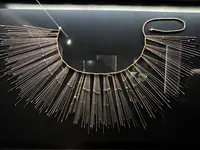
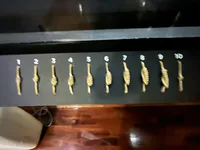
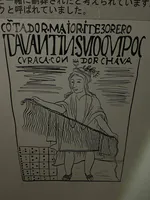
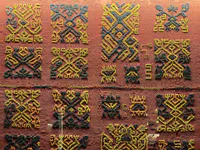
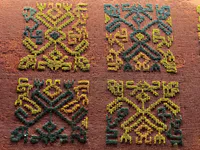
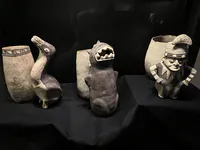
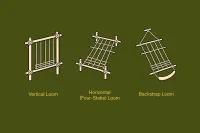
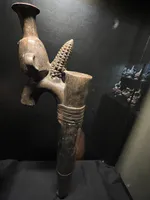 The people of Paracas developed most of the textile techniques known to pre-Columbian cultures, many of which are still used by Peruvian artisans. Fibers and techniques were closely linked to the function of each piece and the status of its wearer. They mastered basic methods such as knotting for nets, looping for three-dimensional textiles, and almost all loom-based constructions. Plain fabrics were first woven in cotton and later increasingly in camelid fiber, especially for funerary wrappings.
They also produced kelim (split tapestry) with cotton warps and wool wefts, as well as a fine, elastic double cloth that began in cotton and in the later period was woven mainly in wool. Discontinuous warps and wefts formed another key technique for creating textiles and designs used in mantles and tunics known as unkus. The gauze technique, which yields light and delicate fabrics, was employed to make garments such as tunics and unkus.
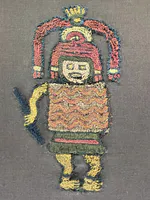
 The people of Paracas worshipped many gods and supernatural beings, influenced in part by Chavín religious traditions. Different representational styles coexisted, from geometric figures linked to the Paracas Caverns period to more complex and detailed deities of the Paracas Necropolis tradition. Human figures often bore supernatural attributes or rich ornaments that identified them as rulers.
Some gods were depicted as flying beings or hybrids combining bird, feline, and human traits, and their costumes were imitated by warriors and priests. Shamans or priests acted as intermediaries between humans, benevolent and hostile deities, and the dead or ancestors. Creatures with feline bodies and serpent-like hair or appendages were especially prominent in the magical world imagined by Paracas culture.
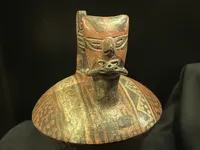 Once the power of the great cult centers and their gods declined, local groups began an autonomous cultural development that led to the flowering of distinct regional traditions. Among the most important were the Nazca, Moche, Lima, Huarpa, and Pukara societies. Located in the deserts of Ica on Peru’s southern coast, the Nazca achieved notable advances in textiles and ceramics. Their multicolored works reflect the legacy of Paracas culture, a connection also evident in the great temple complex at Cahuachi.
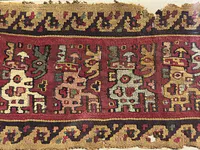
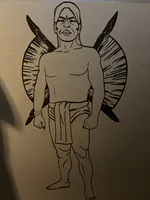
 Nazca men wore loincloths, short tunics, and turbans made from long cloth strips. Nobles displayed embroidered cloaks and long tunics with painted designs or borders adorned with three-dimensional figures; some headdresses were made using the sprang technique. Women wore dresses of varying length below the knee and arranged their hair loose or in braids. Both men and women tattooed their bodies and applied facial or body paint.
One of ancient Peru’s most striking innovations was resist dyeing. Sections of a natural-colored base textile were covered before immersion in hot or cold liquid dyes so those areas remained undyed. In some cases the base consisted of two flexible, loosely structured cloth pieces boiled to soften them. After drying, the threads used to tie knots were removed, leaving geometric motifs—usually concentric diamonds, squares, or circles—where the dye had been blocked. To obtain multiple colors, earlier knots were left in place and new ones added, applying progressively darker dyes from light to dark. This technique allowed a single textile to carry several tones, and in some examples discontinuous construction and resist-dyed patchwork were combined to increase the range of colors.
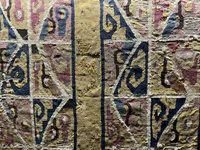
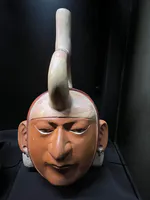
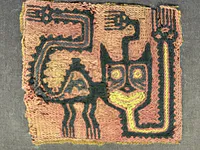 Developed on Peru’s north coast, the Moche were a highly stratified and specialized society that occupied arid territories yet achieved remarkable agricultural and artistic production. They depicted virtually every aspect of daily life and the gods they worshipped in their refined ceramics, and their mythology included numerous deities and supernatural beings.
Among these was the lunar animal, a mythical creature symbolizing the power of gods and rulers and the relationship between the sea and the night sky. The Moche also placed great importance on understanding their environment. A fish known as life, frequently used as an icon, represented seasonal change, fertility, and the renewal of irrigation channels.
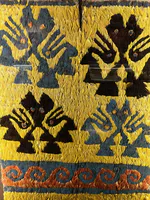
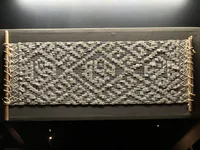 Based in Peru’s southern highlands around Ayacucho, the Wari formed the first Andean empire between 700–900 and introduced a belief system that spread across much of the region. Their religious prestige underpinned extensive conquests. Their stone cities included large, independent complexes devoted to ancestor worship, drainage systems, three-story houses, deep galleries, and one of the earliest road networks, later incorporated into the Qhapaq Ñan.
Craft and ceremonial complexes, together with elite tombs on Peru’s central, northern, and southern coasts, attest to Wari political and religious expansion. Clubs, breastplates, ankle guards, and helmets reveal their military capabilities. Their most representative garments were long tunics, or unkus, made by joining two vertical woven strips. Nobles and warriors wore them, while larger versions covered the funerary bundles of nobles for their final journey to the world of the dead.
The spread of Wari designs shows the empire’s direct influence on other regional cultures, whose styles adopted Wari patterns after contact. In northern and central Peru, researchers have identified fine textiles made under Wari influence. On the northern coast, highland symbols and deities appear alongside local motifs or merged with them, reflecting the reach of Wari iconography and artistic traditions.
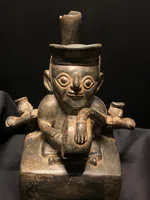
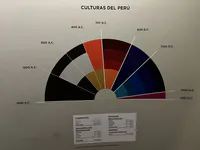
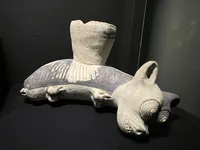 After the decline of Wari society, regional populations influenced by its religion and organizational patterns developed into powerful local lordships. In the north, Lambayeque and Chimú (900–1400), heirs of the Moche, flourished. In the central region, Chancay (1000–1400), Ichma (900–1450), Huarco, and Chincha (1100–1400) developed. Farther south, the Chuquibamba, Chiribaya, and Killke cultures also flourished. The period was marked by long-distance trade and administrative centers for storing and managing resources.
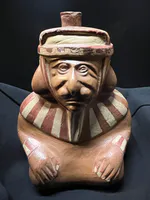 The Lambayeque culture, formed from a blend of Moche and Wari traditions, maintained close ties with its ancestral heritage and built great cities dominated by colossal adobe truncated pyramids. Its main ceremonies included offerings of Spondylus shells to ancestors, numerous deities, and mythical beings who ruled a divine pantheon associated with the sea, agriculture, textile making, livestock herding, and fertility.
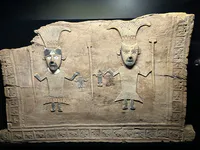
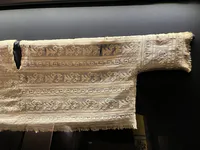 The Chancay emerged on Peru’s central coast as part of a tradition of small regional chiefdoms that, from around 900 AD, developed into a people known for their skill in textiles and ceramics. During the period of Inca expansion, they successfully negotiated a peaceful incorporation into the empire.
This culture created a remarkable variety of textile techniques, including gauze and openwork, lace, double-face weaving, tapestry, patterned wefts, embroidery, resist dyeing, painted cloth, and featherwork. The diversity of their designs and textile objects reflects both the environment they inhabited and their evolving social organization.
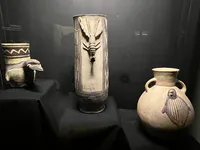
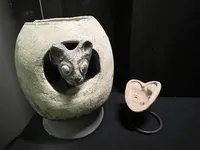 The Chimú were a powerful, well-organized society descended from the Moche that developed on Peru’s northern coast between 900 and 1470. They built one of ancient Peru’s largest adobe cities, Chan Chan, a great walled urban center made up of nine complexes, each with its own plazas, storehouses, audience chambers, and pyramids. These constructions were surrounded by neighborhoods of farmers and producers who supplied the temples.
The Chimú continually expanded their agricultural frontiers to the north, creating an important kingdom capable of extending its influence and conquering other regions, including Lambayeque territory. Renowned metalworkers and textile specialists, they maintained close relations with other lordships such as Chancay and Cajamarca.
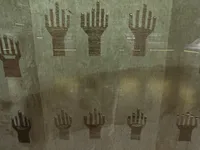
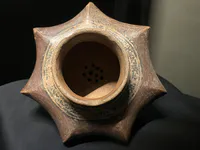 During their early phase as a local group, the Incas skillfully forged relations with neighboring peoples through peaceful alliances and intermarriage among ruling families. Using both diplomacy and warfare, they rapidly integrated other groups into a single polity. The empire rested on a complex social system headed by the Sapa Inca and governed by principles of reciprocity, in which obligations and benefits circulated between ruler and subjects. A vast road network, the Qhapaq Ñan, underpinned imperial economy and political control across extensive territories.
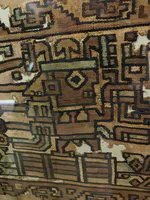
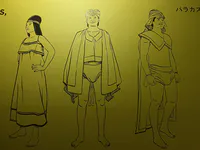
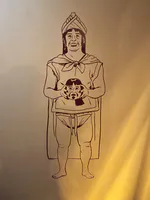
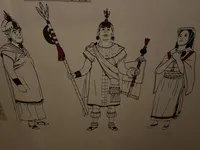
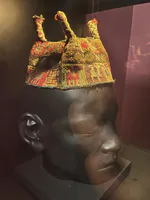
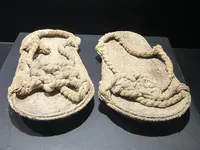
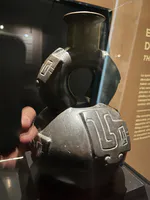 Spanish chroniclers described Inca clothing as a visible marker of social rank, marital status, occupation, regional identity, and royal lineage. Men wore a loincloth (wara) beneath a sleeveless tunic (unku), often with a V-shaped neck opening, and a rectangular mantle (yacolla). They carried small woven bags (chuspa) and wore open-toed sandals (usuta). Headdresses ranged from simple bands to elaborate royal insignia, while hairstyles varied by region and social position. The quality, colors, and patterns of garments distinguished nobles, warriors, and commoners.
Women wore long, round-necked dresses with side openings (anacu), fastened with a tupu pin and belted with a long sash (chumpi) wrapped several times around the waist. A mantle (lliclla) was draped over the shoulders and secured with a tupu. Some noblewomen wore the pampacona, a folded headdress that also covered the upper back. Women’s hair, carefully washed and combed, was worn loose or in fine braids. Fine textiles expressed wealth and authority and were also prized as imperial gifts and sacred offerings.
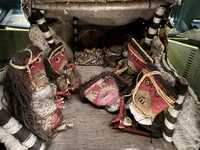
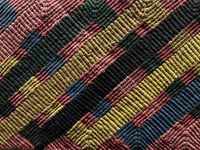 Specialist centers existed where chosen women produced textiles of different grades. These cloths were key instruments of state policy: they were offered as gifts to rulers of peoples the empire sought to annex and given to defeated groups incorporated into Inca systems of tribute and redistribution. For a time after conquest, the victorious Inca wore the traditional dress of the subdued people, while those newly absorbed were allowed to maintain their regional garments, making their origins visible within the empire. According to the chronicles, fine garments were also offered to the gods and burned in large quantities, including the clothing of the ruling Inca, who never wore the same outfit twice.
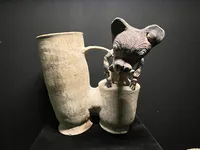 Peruvian textiles embody more than 15,000 years of history. Over this long period, the textiles of diverse ancient cultures underwent continual technological refinement, so that by around 1500 AD they carried a powerful symbolic content widely understood. During the cultural clash brought by the European conquest, native textiles were targeted and burned on a massive scale, since—as with other artistic expressions—they were seen as embodiments of local customs and religious practices.
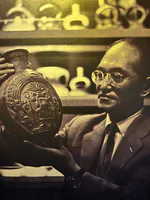
The meanings of much pre-Columbian textile iconography have been lost over time, yet many Indigenous communities still use these symbols, preserving or adapting their significance today. Understanding this heritage requires close engagement with local knowledge to recover a fuller picture of the history and symbolism of Peruvian textiles, now increasingly revalued as part of a shared human legacy and as a foundation for national identity. Within this context, the work of Yoshitaro Amano—Japanese-born naval engineer, entrepreneur, and passionate archaeologist—was crucial: after witnessing the destruction of archaeological sites, he dedicated himself to rescuing looted textile remains, assembling a major collection that preserves some 3,000 years of textile history from cultures such as Chavín, Paracas, Moche, Nazca, Wari, Chimú, Chancay, Lambayeque, Chiribaya, Chuquibamba, and Inca.
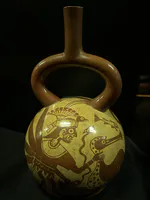
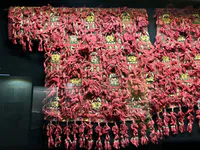 By 20,000 BC, groups in different regions were using woven fibers for protection from climate and their surroundings. In the Mediterranean, sites such as Tell-Halula preserve impressions of woven textiles dating to roughly 3,800–2,500 BC. Finds at Thera (Santorini) provide evidence for some of the region’s earliest red-dyed fabrics.
In China, the discovery of silk transformed textile production and created major trade routes. For centuries, China maintained a state monopoly on silk. Silkworm-rearing and silk-weaving methods were guarded as state secrets, and anyone who revealed them beyond the empire’s borders faced severe punishment. Silk fragments from Shang-dynasty tombs date to the 11th–7th cc. BC.
In India, cotton textiles were being woven by 1750 BC. Cotton cultivation spread from India and parts of Africa throughout the Old World, and cotton became one of its most important textile fibers.
In Japan, textile production probably developed between the 4th and 1st cc. BC, alongside early agrarian culture. By the 4th–6th cc., silk fabrics with woven designs appear in the archaeological record. During this period, strong Korean and Chinese influences helped shape new weaving methods and decorative styles.
This development across multiple regions shows that textile technology emerged independently at different times, as communities adapted local plants, animals, and techniques to make woven cloth.
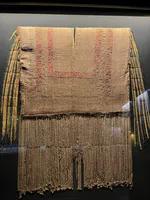
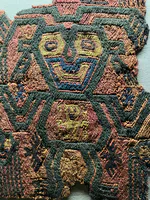 The territory of present-day Peru was first occupied by migratory, seasonally moving groups. Over time, the first sedentary communities emerged, building organized settlements with temples dedicated to early gods and the forces of nature. Around these sacred centers, distinct local traditions slowly formed.
Recent research shows that several of these early temples in different parts of Peru acted as centers of cultural diffusion, radiating new religious ideas, artistic styles, and technical knowledge into surrounding regions from the Lithic, Archaic, and Formative periods onward.
The earliest evidence of textile development in this area is the transformation of raw materials into thread. In Peru, archaeologists have found 10,000-year-old traces of reeds used for woven baskets, and evidence of cotton use dating back some 7,000 years.
Those first tubular strips made from reeds and other plant fibers, and later cotton threads, eventually gave rise to the sophisticated textile art preserved today in this museum. From simple cords and mats, Andean weavers developed an immense variety of fabrics, garments, and ritual cloths that became central to social identity, trade, and religion.
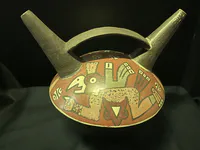
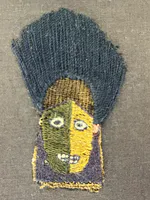 Around 4,500 years ago, more efficient methods of textile production emerged in the central Andes. Abundant natural resources and expanding exchange networks encouraged technological innovation and new forms of artistic expression. These changes brought new specialized roles: some people studied local ecosystems and plants, others spun and dyed fibers, while designers created imagery and architecture. The earliest temples and settlements at sites such as Caral and Las Shicras preserve material evidence of this transformation.
Peruvian textile making developed from rope-making, mat weaving, and basketry. A key innovation was interweaving: crossing threads to create continuous surfaces. During this period, people refined techniques such as netting, braiding, and looping, and cotton was domesticated in the Americas, providing a versatile fiber that could be spun.
Knotting, or anudado, used a single thread knotted repeatedly to form a mesh, mainly for nets. It enabled people to make large, flexible structures with little material, suited to fishing, carrying, or storage. Knotting was one of the earliest ways people transformed simple cord into complex, functional textiles.
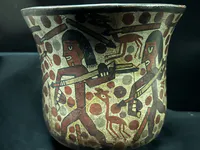
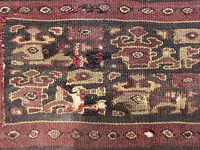 Early Andean societies developed a new form of religion centered on fear and reverence for powerful gods. Priests used visionary plants and trance states to contact and shape divine beings. These encounters with the sacred were expressed through images, rituals, and objects, especially textiles.
Nearly 200 textiles in the Chavín style were found around 1970 at the Karwa site in Ica, alongside human burials. Their dense religious imagery suggests close ties among textile art, funerary practice, and the earliest Andean pantheon.
The painted designs were probably applied with brushes or cotton swabs of different thicknesses, sometimes with flexible stencils to help repeat complex patterns. Common colors include brown, orange-red, purple-brown, olive green, and turquoise green. Some textiles show resist-dyeing, while others were dyed throughout, including examples in deep blue. The dyes came from mineral, plant, and animal sources.
Although conclusive evidence is lacking, these textiles may have served as teaching aids for myths and rituals or as temporary ceremonial garments. Unlike stone or wall paintings, textiles could be folded, carried over long distances, and exchanged easily.
Because they were portable, Karwa textiles probably circulated alongside other prestige goods, including decorated ceramics, dried fish, semi-precious stones, and pigments. Together, these goods may have helped spread images of the first Andean gods through a wide religious and economic network.
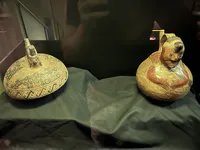
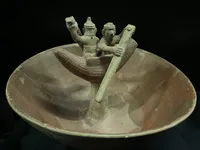 The emergence of pottery, another major technological breakthrough, created a new medium for representing beliefs, priests, and gods. Through firing, soft clay was transformed into a stone-like material, and these vessels could be used to transport large quantities of liquids or to cook food. Pottery thus expanded both daily possibilities and the visual language of ritual life.
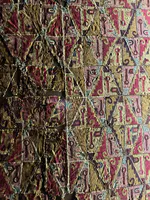
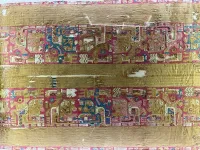 The Paracas people developed a wide range of textile techniques, many of which remain in use among Peruvian artisans. Fibers and methods were closely matched to each garment’s function and the wearer’s social status.
They used knotting to make nets, looping to create three-dimensional fabrics, and many forms of loom weaving. Plain-weave textiles have been found first in cotton and later in camelid wool, particularly among the wrappings of funerary bundles.
Other techniques included slit tapestry, or kelim, woven with cotton warps and wool wefts. Double cloth, a fine, elastic structure, was first made in cotton but was woven mainly in wool by the final Paracas phase.
Discontinuous warps and wefts created patterned cloth, especially mantles and shirts called unkus. Gauze weaving produced light, delicate textiles used for tunics and other unkus.
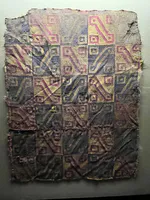
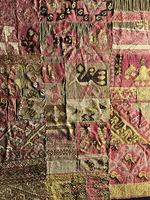 The Paracas people worshipped many gods and supernatural beings. The rise of these deities was influenced by earlier religious traditions such as Chavín. Human figures are often shown with supernatural attributes or ornaments that identify them as rulers or sacred specialists, while more geometric, abstract designs are linked to the early Paracas Caverns phase.
In the later Necropolis phase, depictions of gods become more complex and detailed. Some deities appear as flying beings—hybrid creatures combining bird, feline, and human traits—whose costumes were imitated by warriors and priests. Creatures with feline bodies and hair or appendages shaped like serpents dominate the Paracas mythical world, embodying raw forces of nature such as power, danger, and transformation. Shamans or priests served as intermediaries between humans, benevolent and malevolent deities, and the dead or ancestral spirits, using this imagery to move between worlds.
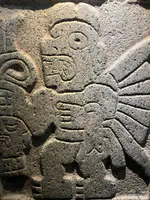
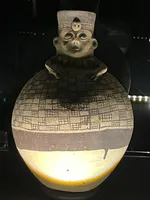 Once the great ceremonial centers and their ancient gods lost power, local groups began to develop autonomously, giving rise to distinct regional cultures. From this process emerged societies with their own styles, rituals, and visual languages. Among the best known of these regional traditions are the Nazca, Moche, Lima, Huarpa, and Pukara cultures, each rooted in a specific landscape yet linked by shared Andean notions of reciprocity, sacrifice, and sacred landscape.
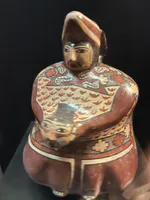
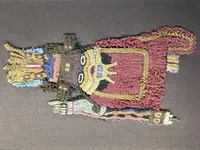 Located in the deserts of Ica on Peru’s southern coast, the Nazca society achieved remarkable advances in both textiles and ceramics. Their multicolored works reveal a deep inheritance from Paracas culture, visible in their use of color, abstraction, and ritual iconography. The great ceremonial center of Cahuachi, with its temples and plazas, also testifies to this continuity: Nazca priests and artisans reinterpreted earlier desert traditions, turning the arid landscape itself into a canvas for lines, geoglyphs, and sacred processions.
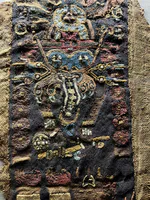
 Nazca men wore loincloths and short tunics, often combined with turbans made from long bands of cloth. Nobles displayed embroidered mantles and long tunics with painted designs or borders embellished with small three-dimensional figures. Some headdresses were made using sprang, a technique based on interlinking stretched threads.
Women wore dresses of varying lengths that fell below the knee and arranged their hair either loose or in braids. Both men and women tattooed their bodies and used facial and body paint, turning the human figure into a living, moving support for color and sacred imagery.
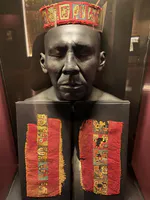 Resist dyeing is one of the most impressive techniques developed in ancient Peru, and similar methods are known from other parts of the world. Resist refers to covering certain sections of the cloth or specific design areas before immersing the textile in liquid dye, in hot or cold water, so that those protected areas remain undyed.
To begin the process, artisans prepared a natural-colored base textile, sometimes formed by two panels sewn together into a flexible, loosely woven cloth that could be easily folded, twisted, and bound. Sections were tightly wrapped or knotted with threads before each immersion in dye.
Once the textile had dried, the threads holding the knots were removed, leaving geometric figures where the dye had been blocked. These reserved shapes commonly appear as concentric diamonds, squares, or circles. If more than one color was desired, the existing knots were not untied; instead, new bindings were gradually added so that further colors could be introduced while preserving earlier ones.
Using this technique, a single cloth could carry multiple colors and tones. The process began with the lightest dyes, then progressed to darker shades applied without loosening the knots. In some examples, separately dyed resist patches were joined in a kind of patchwork, allowing an even wider range of color and pattern. By combining resist dyeing with patchwork construction, Nazca weavers created textiles of striking visual complexity from relatively simple operations.
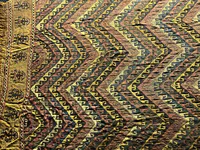
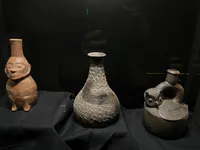 The Moche (100–800 AD): Textile Workshops on the North Coast
Developed on Peru’s north coast, the Moche culture is a classic example of social stratification and specialization. Controlling arid coastal valleys through irrigation, the Moche achieved high agricultural productivity and an extraordinary artistic output.
They recorded nearly every aspect of earthly life and the actions of the gods in their refined ceramics and textiles: warfare, sacrifice, farming, ritual dances, and processions of animal–human hybrids. Mythical beings linked to the moon, water, and seasonal floods frequently appear, symbolizing the close relationship between divine power, political authority, and the fragile coastal environment.
Moche textile workshops mirrored this hierarchy and complexity. Specialists in spinning, dyeing, and weaving produced elaborate garments for elites and ritual performances, while simpler cloth served everyday needs. Together, these textiles formed a second skin for Moche society, wrapping bodies, burials, and sacred spaces in images of power and transformation.
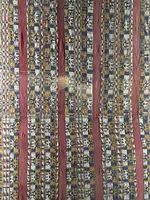 Several gods and supernatural beings appear in Moche mythology. One of the most important is the lunar animal, a mythical creature that symbolizes both the power of deities and rulers and the intimate relationship between the sea and the night sky. The Moche also placed great importance on understanding their environment. A fish known as life, frequently used as an icon, represented seasonal change, fertility, and the renewal of irrigation canals. Together, these beings linked celestial cycles, ocean tides, and agricultural abundance into a single sacred system.
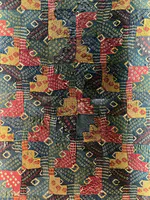
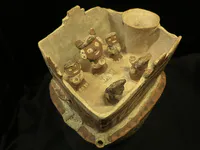 The Wari Empire developed in the southern highlands of Peru, around Ayacucho, and marked the beginning of a new belief system that spread across much of the Andean region. Wari religious prestige underpinned the conquest and integration of vast territories. Their cities were built in stone and organized into large, independent complexes devoted to ancestor worship, complete with drainage systems, multi-story houses, and deep galleries.
The Wari also created one of the earliest large-scale road networks, a precursor to the later Qhapaq Ñan, which helped bind together distant regions. Archaeological finds of ceremonial complexes, craft workshops, and elite tombs on the central, northern, and southern coasts show the reach of their political and religious influence. Weapons such as clubs, breastplates, ankle guards, and helmets attest to their military capabilities, which reinforced Wari authority over subject peoples.
Long tunics known as unkus are the most emblematic woven garments of this society. They were made by joining two vertical strips of cloth, sewn along the center and sides into different sizes and models. Unkus were worn by nobles and warriors, while larger versions served as outer coverings for great Wari funerary bundles, dressing elite individuals for their final journey into the world of the dead.
The spread of Wari designs demonstrates how strongly their empire influenced other cultures of ancient Peru. Regional societies imitated Wari styles once they came into contact with the empire. In northern and central Peru, especially, fine textiles show Wari impact: on the north coast, highland symbols and deities began to appear, sometimes fused with local motifs. This blending of imagery reveals how Wari iconography was adapted to diverse regional traditions.
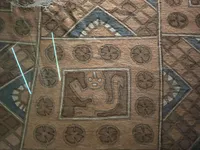
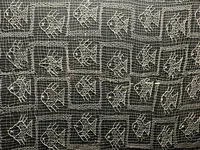 After the decline of the complex Wari society, regional populations—deeply shaped by Wari religious and organizational models—developed into powerful local kingdoms and lordships. In the north, Lambayeque and Chimú emerged as heirs to the Moche tradition; on the central coast, Chancay, Ichma, Huarco, and Chincha rose to prominence; in the south, cultures such as Chuquibamba, Chiribaya, and Killke flourished.
This period is characterized by long-distance trade networks and administrative centers designed for storing and redistributing resources. Together, these regional powers laid much of the political and economic groundwork that the later Inca Empire would inherit and reorganize.
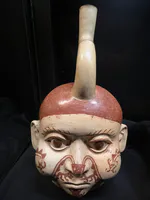
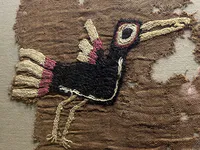 The Lambayeque culture, formed from the fusion of Moche and Wari stylistic traditions, maintained strong ties with the beliefs and practices of its ancestors. Its people built great cities dominated by colossal truncated adobe pyramids, which served as ceremonial and political centers.
Among their main rituals were offerings of Spondylus shells to ancestors, numerous deities, and mythical beings. These figures presided over a divine pantheon closely linked to the sea, agriculture, textile production, animal husbandry, and fertility. Lambayeque art and architecture thus reflect a world in which political authority, sacred power, and ecological cycles were deeply intertwined.
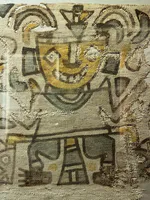 Developed on Peru’s central coast, Chancay society formed part of a tradition of small regional chiefdoms that, after around 900 AD, rapidly flourished as communities of peaceful, highly skilled textile makers and potters. During the period of Inca expansion, Chancay leaders successfully negotiated a peaceful incorporation into the empire.
Chancay weavers created a remarkable variety of textile techniques, including gauze and openwork, lace, double-faced weaving, tapestry, patterned weft structures, embroidery, resist dyeing, painted cloth, and featherwork. They also produced a wide range of textile objects—mantles, garments, ritual hangings—whose designs reflect both their coastal environment and their evolving social complexity.
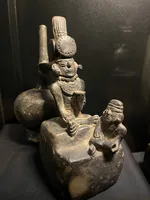
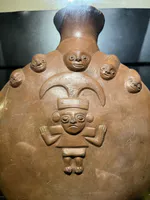 The Chimú were a powerful and highly organized society descended from the Moche, flourishing on Peru’s northern coast between roughly 900 and 1400 AD. They built Chan Chan, one of ancient Peru’s largest adobe cities: a vast walled urban complex made up of nine major compounds, each with plazas, storerooms, audience halls, and pyramids. Around these core precincts spread neighborhoods inhabited by farmers and craft producers who supplied the temples and palaces.
By continually expanding their irrigated fields northward, the Chimú created a major kingdom capable of extending its influence over neighboring regions, including territories associated with the Lambayeque culture. Chimú metalworkers and textile specialists maintained close relationships with other lordships, such as Chancay and Cajamarca, weaving a network of artistic and political alliances that prefigured, and later confronted, Inca expansion.
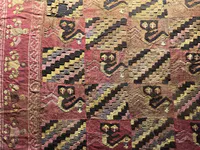
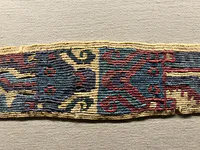 During their early phase as a local group, the Incas skillfully forged relationships with neighboring peoples. They built peaceful alliances and created kinship ties among ruling families, which enabled them to incorporate other communities through diplomacy or, when necessary, warfare. The empire rested on a complex social system headed by the Sapa Inca and structured around reciprocity: subjects offered labor and tribute, and the state responded with protection, food, and public works. A vast road network known as the Qhapaq Ñan underpinned imperial power, allowing the flow of goods, armies, and information across the Andes.
Chroniclers describe Inca clothing in detail, noting how dress signaled social status, marital situation, occupation, and even lineage within Tahuantinsuyo. Men wore a loincloth (wara), a sleeveless V-neck tunic (unku), a mantle or cape (yacolla), a small bag (chuspa), and a range of headdresses from simple bands to crowns and helmets. Sandals (usuta), woven from different materials, left the toes exposed. Hair could be worn in a ponytail or cut to various lengths. Women wore long, round-necked dresses with side openings (anacu), fastened with large pins (tupu) and cinched at the waist with long sashes (chumpi). A shoulder mantle (lliclla) was pinned with a tupu, and noblewomen sometimes used a folded headdress called pampacona that also covered the shoulders. Women’s hair was carefully washed, combed, and worn loose or in fine braids.
Textiles were central tools of imperial politics and identity. Specialist workshops of chosen women produced cloth of varying quality for state use. Fine fabrics served as diplomatic gifts to rulers whom the Incas hoped to annex, and as part of the tribute and redistribution systems imposed on defeated peoples. Conquering Inca rulers would temporarily wear the traditional dress of a newly subdued group, while those incorporated into the empire were allowed to keep their regional styles—making origin visible in clothing. Chronicles also note that sumptuous garments were burned as offerings to the gods, often in great quantities; even the Sapa Inca’s own clothes were never reused but ceremonially destroyed. In this way, textiles functioned both as instruments of statecraft and as powerful symbols of status, piety, and belonging.
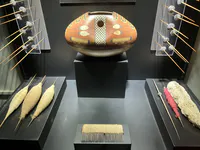
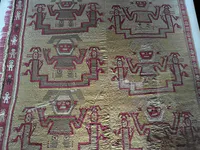 The Textile Tradition, Designs and Symbolism: The Amano Textile Collection
This exhibition spans more than 15,000 years of history. Over this long period, textiles from diverse ancient Peruvian cultures underwent continuous technological refinement. By around 1500 AD, many woven pieces carried a dense symbolic charge that was widely understood. During the European conquest and the resulting cultural clash, native textiles—like other artistic expressions—were targeted for destruction as embodiments of local customs and religious beliefs. Large quantities were burned, contributing to the loss of irreplaceable visual traditions.
The precise meanings of many pre-Columbian textile icons have been lost over time. Yet numerous indigenous communities in Peru still use inherited symbols, preserving or adapting their significance to contemporary life. Traditional textiles remain saturated with motifs and forms. For this reason, contact with local knowledge is essential to reconstruct a fuller picture of the history and symbolism of Peruvian weaving. These works constitute a major legacy of humanity. Today, pre-Columbian and traditional textiles and motifs are being revalued by institutions and industries alike. Embracing this artistic, symbolic, and cultural heritage is vital for building a renewed sense of national identity. With this goal, the Amano Museum makes available to visitors and researchers the materials and motifs assembled by its founder, Mr. Yoshitaro Amano.
Yoshitaro Amano, born in Akita, Japan, was a successful naval engineer and businessman, as well as a passionate student of archaeology. After settling in Peru, he traveled widely through archaeological sites and witnessed the destruction caused by looting. Determined to rescue what remained, he collected objects left behind by looters and gradually formed one of the country’s finest textile collections. More than fifty years ago, he deposited his entire collection in this museum. Today it preserves and conserves over 5,400 textile pieces, primarily from the Chancay culture, along with important examples from Chavín, Paracas, Moche, Nazca, Wari, Chimú, Lambayeque, Chiribaya, Chuquibamba, and Inca traditions—offering an unparalleled window into three millennia of textile history.
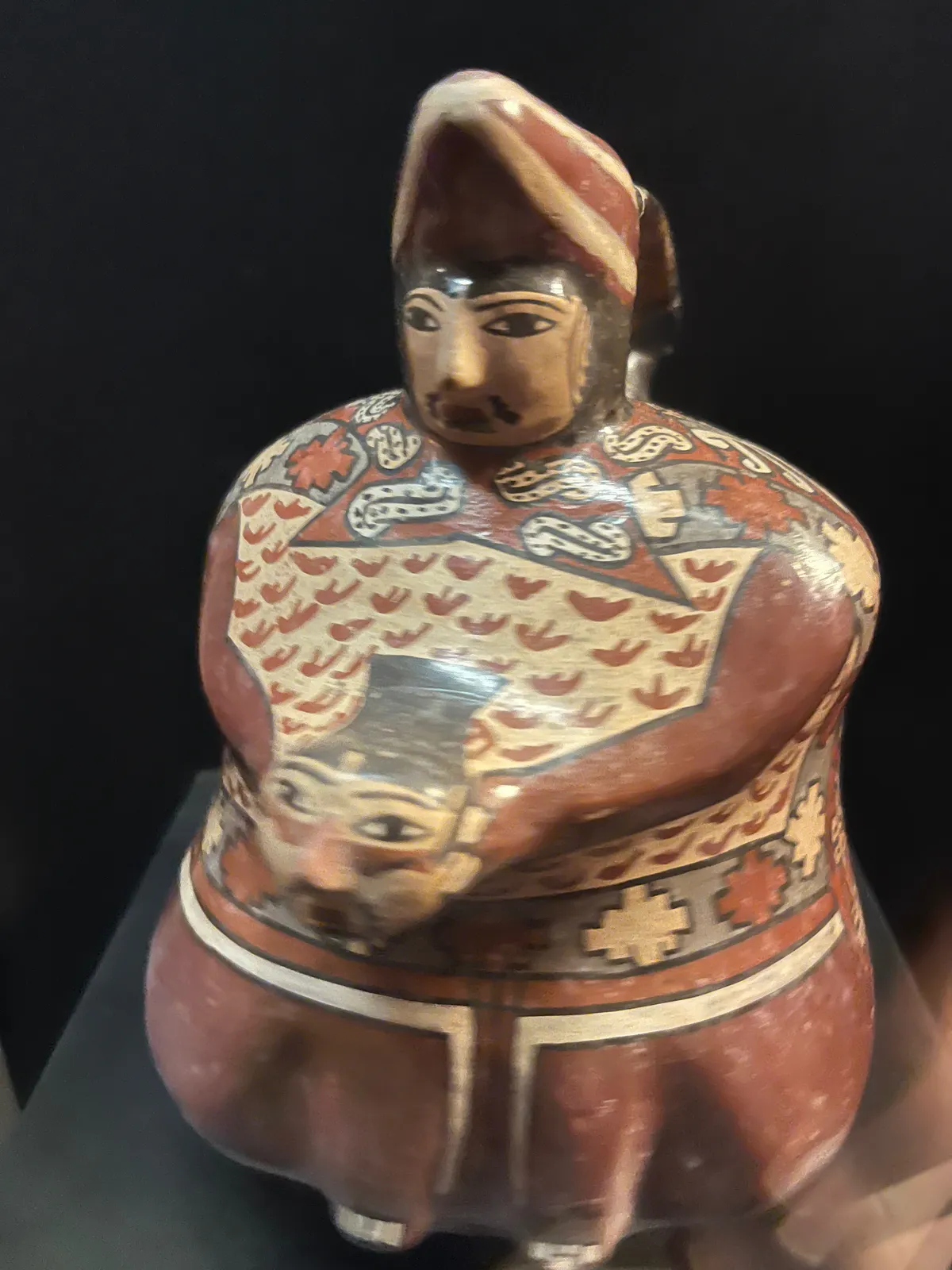
Nazca Nobleman with Trophy Head
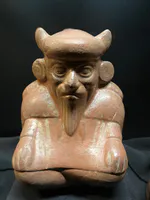
This Nazca ceramic vessel (200 BC–600 AD) depicts a seated nobleman holding a severed trophy head. He wears a patterned tunic, cloak, loincloth, and turban, rendered in red, cream, black, and gray. Known in Nazca iconography as the Beheader, the figure reflects the ceremonial importance of trophy heads, which connected ritual decapitation with warfare, fertility, and renewal in ancient Peru.
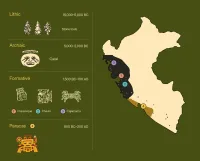
Explore by type and place