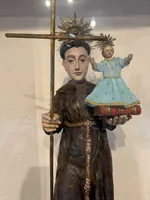
Saint Anthony as a Military Captain
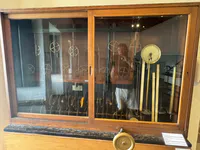
Longitude Calculation Device
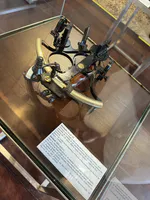
Marine Sextant
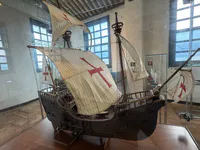
Portuguese Carrack São Gabriel
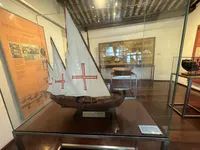
Portuguese Caravel Model
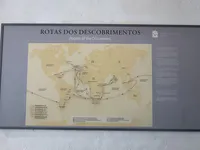
Portuguese Maritime Explorations
A Bahian Saint’s Unusual Rise Through the Army Ranks
Brazil, a strongly Catholic country, long saw the Church present in every sphere of social life, including the army. In Salvador, the image of Saint Anthony at the Forte da Barra—also the city’s first patron saint—was officially given a soldier’s rank and pay in the mid-17th c., and promoted to captain in 1705. This unusual military appointment illustrates both the Church’s cultural influence and the popular reach of Catholic devotion in Bahia. The saint’s image continued to receive promotions and corresponding salaries for centuries, until it was finally removed from the army payroll in 1912, by which time it held the rank of lieutenant colonel.
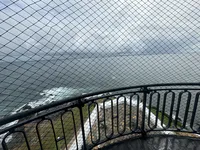
View from Farol da Barra
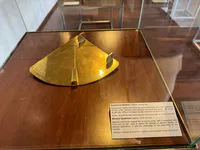
Nautical Quadrant
Amerindians and the Origins of Brazil
Thirty to forty thousand years ago, the ancestors of today’s Indigenous peoples crossed the Bering Strait during the Ice Age and gradually peopled the Americas. When the Portuguese reached Brazil in the 16th c., Todos os Santos Bay was inhabited by the Tupinambá, distant descendants of those migrants. They had expelled the Tupiniquim from this fertile region and lived in groups of 500 to 3,000. Early missionary Father Manoel da Nóbrega described them as very warlike, highly sensual, and skilled hunters, fishers, and farmers.
To convert and control the Tupinambá, the Church established missions along the coast and inland, aligned with colonial conquest and settlement. Indigenous people were forced into labour and subjected to Jesuit evangelisation. Yet Indigenous culture endures in place names for towns, rivers, and hills, in Brazilians’ love of bright colours and frequent bathing, and in culinary practices such as cooking with manioc and grilling meat on skewers.
To convert and control the Tupinambá, the Church established missions along the coast and inland, aligned with colonial conquest and settlement. Indigenous people were forced into labour and subjected to Jesuit evangelisation. Yet Indigenous culture endures in place names for towns, rivers, and hills, in Brazilians’ love of bright colours and frequent bathing, and in culinary practices such as cooking with manioc and grilling meat on skewers.
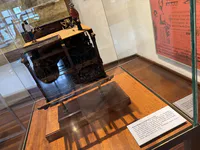
Slave Ship Vigilante Cutaway Model
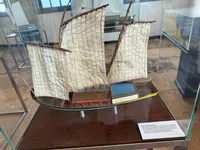
Boat from the Recôncavo
The Galleon Santíssimo Sacramento: Shipwreck and Empire
On the night of 5 May 1668, cannon at the Forte de Santo Antônio da Barra announced the arrival of the galleon Santíssimo Sacramento at the entrance to Todos os Santos Bay. A violent storm near the anchorage drove the ship off course as it approached port, and it sank around 11 p.m. Among the dead were the incoming governor-general of Brazil, the captain, several clerics and nobles, and many families. The death toll approached 400; barely some 70 people survived.
The Santíssimo Sacramento, a 500-ton galleon armed with about sixty iron and bronze cannon, was built between 1650 and 1651 at the Ribeira das Naus shipyard in Porto, northern Portugal. It belonged to the Companhia Geral do Comércio do Brasil, founded in 1649, which maintained its own war fleet to escort merchant convoys on the Brazil run, linking commercial interests, naval power, and colonial expansion.
The Santíssimo Sacramento, a 500-ton galleon armed with about sixty iron and bronze cannon, was built between 1650 and 1651 at the Ribeira das Naus shipyard in Porto, northern Portugal. It belonged to the Companhia Geral do Comércio do Brasil, founded in 1649, which maintained its own war fleet to escort merchant convoys on the Brazil run, linking commercial interests, naval power, and colonial expansion.
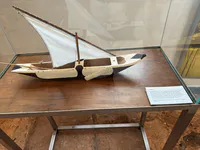
Bahian Sailing Canoe
Bahia Nautical MuseumMuseu Náutico da Bahia
Bahia Nautical Museum is housed in the 16th-c. Santo Antônio da Barra Fort beside the Barra Lighthouse, at the Atlantic edge of Salvador. Its galleries frame All Saints Bay as both frontier and highway, tracing Portuguese expansion in the 15th–16th cc., local craft from the Recôncavo, and the navigational instruments that turned stars and time into position. Models of coastal defenses and the slave ship Vigilante keep the story honest about how science, faith, and violence shaped Bahia—echoed in the fort’s St Anthony, symbolically promoted to captain in 1705.
Explore by type and place