2019 © Maxim Tabachnik
 The Swiss psychologist Carl Gustav Jung coined the term analytical psychology, or the psychology of complexes, to describe his own theoretical and clinical approach, distinguishing it from the psychoanalysis developed by Sigmund Freud.
According to Jung, the human unconscious has a relatively superficial layer that is personal, formed by each individual’s life experiences. Beneath this lies a deeper, innate layer: the collective unconscious. He called it collective because it is universal in nature—its contents and patterns of behavior are essentially the same everywhere and in all human beings.
The collective unconscious is made up of archetypes. An archetype is essentially an unconscious pattern that, when it surfaces into awareness, takes on a specific form in each person, shaped by that individual’s culture and personality. All the inherited information accumulated over the course of human evolution is stored there in the form of symbols and predispositions.
Among the many archetypes Jung identified, a small group—such as the Self, the Shadow, the Anima/Animus, the Persona, and the Wise Old Man/Woman—achieved a higher level of development and influence than the rest. These deep patterns underpin myths, religions, dreams, and many recurring images in art and literature across cultures.
 The final fragment in this group (about modern art, the Great Depression, and artists in New York) is too garbled and incomplete to be reliably reconstructed. Words, names, and sentences are cut off in ways that make the original meaning unclear. To avoid inventing content or distorting the historical information, it’s safer not to fill in the missing parts. If you can capture a clearer photo or scan of that text, I can then translate or rewrite it accurately in English.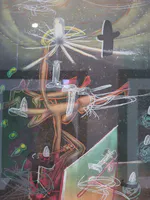
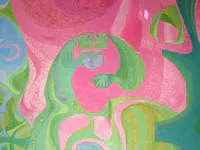
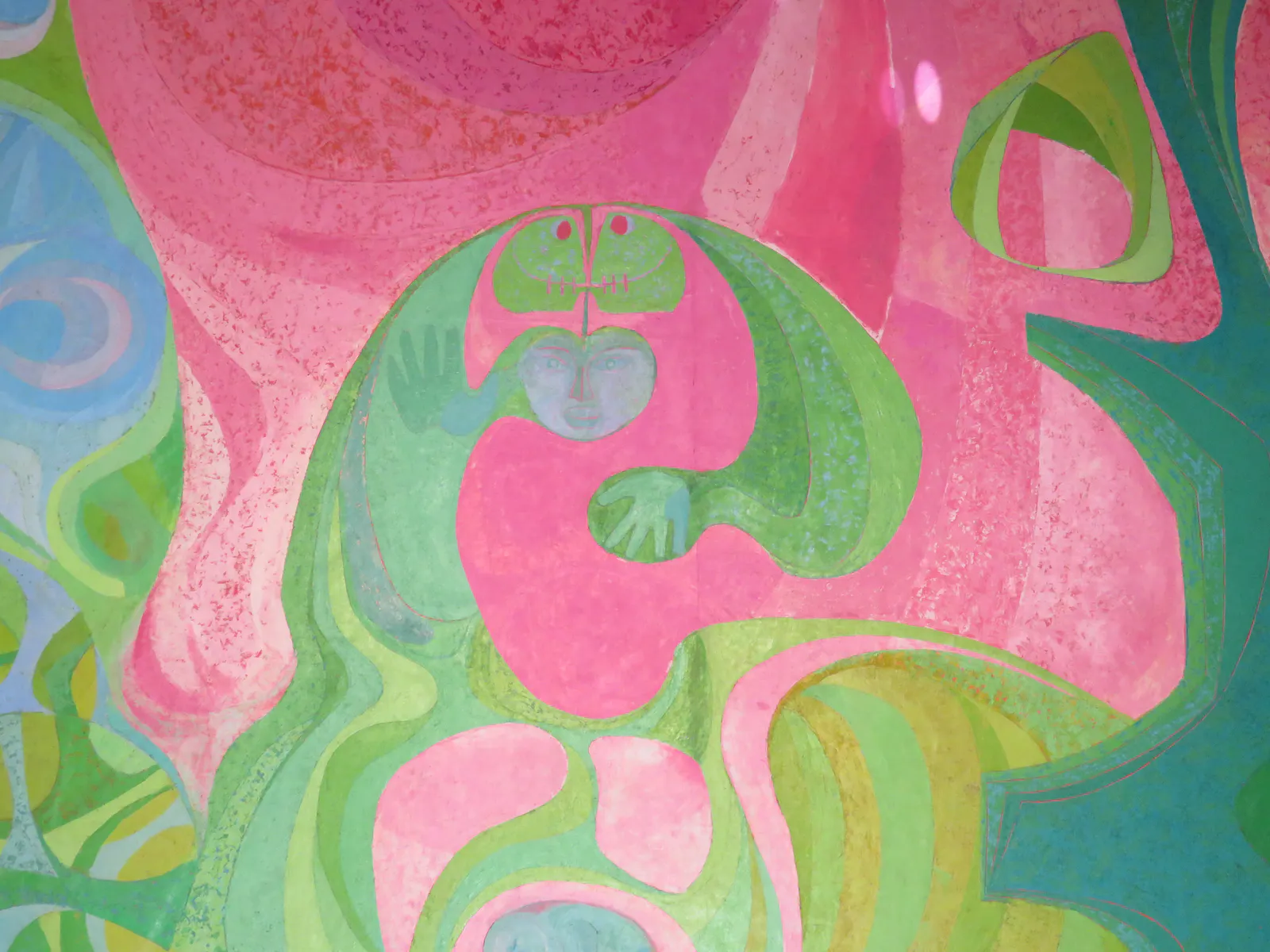
Jade MurmursPedro Coronel
Pedro Coronel’s 1973 oil painting, Jade Murmurs, exemplifies abstract expressionism with organic shapes and vibrant colors. A central figure in green and blue contrasts with a pink textured background, inviting contemplation of duality and cosmic connection. Coronel’s work often explores the universe’s mysteries, reflecting humanity’s intertwined existence with the cosmos.
Explore by type and place